
Auto Body Repair Techniques
Image

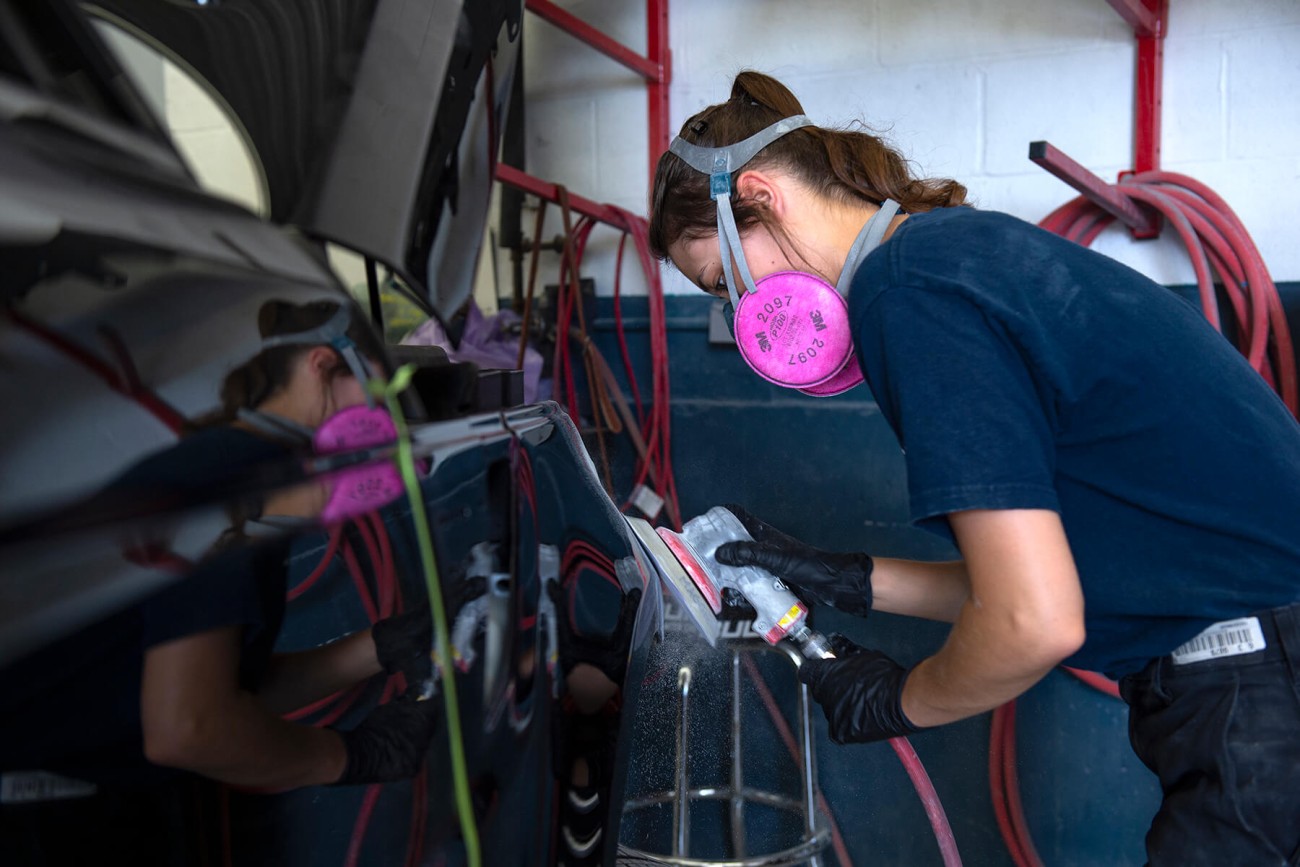
An auto body repair technician works with their hands, has variety in their day-to-day tasks and sees their work take shape before their eyes. They are also in high demand as manufacturers continue to develop vehicles using new materials and methods that demand cutting-edge repair techniques, tools and materials. Courses provide technical training on the practical skills used by entry-level auto body repairers: welding, refinishing, metalworking and body repair. While in the program, you will have numerous opportunities to perfect your craftsmanship in our state-of-the-art auto body repair shop and develop a strong foundational understanding of the technologies and techniques used in the field.
You will also learn how to assess vehicle damage, develop repair estimates using proper etiquette, work with common industry software and learn the fundamentals behind shop operation. These are all important skills for graduates to succeed in the auto body and collision damage repair trade and thrive in this high demand industry. Arrangements will be made for graduates of this program to write the level one apprenticeship exemption exam, rewarding them one year's credit toward their three-year apprenticeship schooling.
Graduates of Fanshawe’s Auto Body Repair Techniques program are well prepared to enter the workforce as an auto body apprentice. They may choose to accelerate the apprenticeship by writing the exam for Ontario College of Trades Apprentice Training Standard for Auto Body (Branch 1). Graduates may work as an estimator, insurance company appraiser or with an after-market supply company.
Did you know Fanshawe consistently ranks high in graduation employment rates among large colleges in Ontario?
Here are some examples of career opportunities for graduates of Fanshawe’s Auto Body Repair Techniques program:
Mechanical Warranty Claims Adjuster
Evaluate the damage done to a vehicle and determine whether or not an insurance plan covers the repair costs. This is an opportunity for someone with experience in the automotive mechanical trade and an interest in trading in the wrench for a desk.
Automotive Body Painter
Prepare and mask repaired panels, refinish to paint manufacturer and colour specifications and polish to complete the job.
Autobody Tech
Perform many types of auto body repair to make a damaged car look as good as new.
The graduate has reliably demonstrated the ability to:
1. Under appropriate supervision, repair and refinish damage to automotive bodies and frames, and inspect and repair vehicle safety devices.
2. Under appropriate supervision, use diagnostic equipment and basic repair techniques to service automotive power train, tires and rims, fuel and electrical systems, and heating, air conditioning and cooling systems.
3. Repair rust on vehicles and apply corrosion protection where appropriate.
4. Access information to remain current with advanced trade techniques in auto body repair.
5. Assess vehicle damage and provide repair estimates to clients.
6. Perform basic auto body business accounting to calculate inventory, damage and repair estimates.
7. Make ethical business decisions when conducting sales and interacting with clients. 8. Communicate effectively to build and maintain client relationships.
James Shaw
OSSD (with courses from the College (C), University (U), University/College (M), or Open (O) stream), or equivalent, or mature applicant.
Students who do not have a high school diploma may wish to consider taking the Academic and Career Entrance (ACE) grade 12 Equivalency Certificate.
| Test | Score |
|---|---|
| TOEFL iBT (2026) | Overall score of 4.5 with no score less than 4 in any band |
| TOEFL i8BT (Prior to 2026) | 79 |
| IELTS Academic | Overall score of 6.0 with no score less than 5.5 in any of the four bands |
| CAEL | Overall score of 60 with no score less than 50 in any of the four bands. score of 80 in listening |
| PTE Academic | Minimum score of 53 with no score less than 45 in any of the four bands |
| Cambridge English | Overall score of 169 with no language skill less than 162 |
| ESL4/GAP5 | Minimum grade of 80% in Level 8, 75% in Level 9, or 70% in Level 10 |
| Duolingo | Overall score of 105, with no score lower than 95 |
| LanguageCert Academic | Overall score of 65 with no score less than 60 in any of the four skills |
| Level 1 | ||||
| ATBR-1019 | Auto Body Work Practices | 2.5 | ||
| This course will introduce students to the everyday work practices of the auto body industry. Upon completion, the student will be able to practice safe workplace procedures, apply WHMIS (Workplace Hazardous Materials Information System), identify causes of accidents and develop preventive measures. Students will be familiar with the acts and laws pertaining to auto body and collision damage repair. Students will also gain a working knowledge of the hand tools and equipment, including different fastening hardware and materials, used within the auto body industry. | ||||
| WELD-1059 | Automotive Welding | 3.5 | ||
| This course will prepare students to use welding equipment common to auto body and collision damage repair. Students will learn safe handling and set-up procedures and identify common workplace welding and cutting hazards. Students will weld automotive steel in a variety of joint setups, including overlap and butt joints. Students will become familiar with common auto body procedures of welding and cutting using plasma cutters, oxy-acetylene torches, aluminum and steel MIG (MAG) welders, and TIG welders. | ||||
| ATBR-1032 | Auto Body Frame & Structure | 6 | ||
| An understanding of auto body frame and structure design is foundational knowledge for auto body repairers. This course will enable students to identify various cosmetic and structural vehicle design concepts and manufacturing processes. The students will learn the logic behind various styles of body and frame design and use this knowledge to fabricate and replicate auto body designs. Students will also apply non-structural repair principles and procedures to common collision damage. Students will use various types of corrosion protection to maintain vehicle structural integrity and will work with vehicle safety systems. | ||||
| ATBR-1031 | Auto Body Mechanical | 3 | ||
| In this course students will learn the fundamental | ||||
| ATBR-1023 | Trade Calculations | 2 | ||
| This course provides students with the trade-related math skills used in common auto body shop operations. Students will learn basic formulas, calculations, and units of measuring used for autobody accounting, mixing paints, measuring vehicles, welder calibrations, and metal fabrication.The students will also apply these basic math skills to typical office tasks such as job costing, calculating overhead costs, and processing payroll. | ||||
[1] Total program costs are approximate and subject to change. They do not include additional fees such as the health and dental plan, bus pass, or general expenses. Learn more about ancillary and additional fees.


