
Passing on expert knowledge and skills to students may seem like it’s the most critical part of teaching, but it is equally important to evaluate whether learning has happened. The course outline and course plan identify what formal evaluations are in each course:
The course outline indicates evaluation types, total grade weights, and learning outcomes they assess.
The course plan details the sequence, timing, and weights of individual evaluations, and may indicate whether they are done in-class or online.
If there are existing evaluation materials (e.g., assignment instructions, tests, grading schemes, etc.) are available, the academic manager or program coordinator will detail how these can be accessed, and may also relay whether changes to these evaluations are permitted.
Faculty who need to create their own evaluations can refer to Chapter 5 of The Centre for Teaching and Learning's CODE Book for guidance on creating effective evaluations that align with learning outcomes. Many courses may already have a course textbook or OER that include test banks or online activities that can be used as a starting point for evaluation creation. Additionally, program coordinators or other faculty in the program can advise on evaluation types to work best, as well as appropriate length, level of difficulty, and mode of delivery, i.e., in person, online, or take-home). Of course, AI tools such as MS Copilot can help draft assignment descriptions and test questions quickly, provided that output is human-checked for accuracy and relevance. For more information on integrating AI tools in teaching, see AI and Ed Tech here on the Hub.
Giving Student Grades and Feedback
A mark or grade represents an evaluation of the students’ performance, whereas feedback is the information that provided to students that describes how they are doing in relation to their goal (i.e., achieving the learning outcomes). Feedback is provided so that students know why they received a particular score, and to create awareness of how to improve. To many students, this is more important than the grade itself! Therefore, effective feedback should be:
Outcomes-focused
Timely and on-going
Consistent
Clear and actionable
Learner-centered (adapted from Wiggins, 2012)
The College recognizes that consistent, fair, and timely evaluation is critical to student success. The recommended response time for providing feedback on evaluations is no more than ten business days, but some schools or campuses may have more stringent requirements.
Awarding Grades
In order to assign student grades fairly, consistently, and in a way that distinguishes between levels of student success, grading criteria should be available to students when an assignment is made available.
Every evaluation should have a grading scheme, or tool used to measure and assign a grade to students’ achievement of the learning outcomes. These might take the form of a rubric, checklist, answer key, rating scale, etc. Faculty should review the grading scheme with students in class and make sure it is available to students, either in class or (better yet) posted to FOL as a document or through one of its scoring tools. See the example rubric below, and click the information icons (i) for an explanation of each area:
Entering Grades into FanshaweOnline
It is a College requirement that all student grades be entered by the professor into FanshaweOnline within a reasonable period of time. This provides a predicable location for students to see their assessment performance, and for students and faculty to track student progress. Each evaluation tool on FanshaweOnline (quizzes, submission folders, discussions, etc.) has an area to set up and enter student grades and feedback. Marks can also be entered directly into the grade book. If the grade book for your course has not been set up for you, or if you need any assistance with the grade entry process on FanshaweOnline, contact your School or Campus’ Educational Support Technologist (EST).
Image
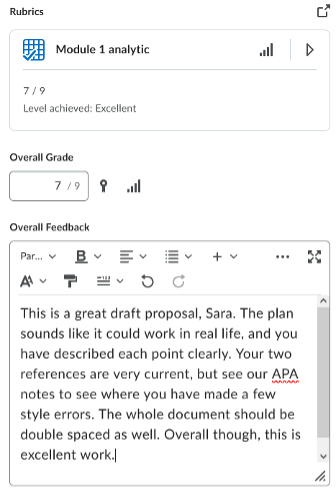
FOL Help Documentation: Grades, Rubrics
FOL Help Videos: Enter Grades, Create a Holistic Rubric, Create an Analytic Rubric
For more information about creating rubrics for your course, refer to Chapter 5 of The CODE Book.
Getting Student Feedback
Not sure what your students think of your teaching? You can ask them! Just as you are providing your students with formative feedback to support their learning, you can ask them for formative feedback on your teaching.
Informal Feedback
Consider surveying your students early in the semester (around Week 3 or 4) to ask them a few brief questions to find out what they like about your class and how you can improve. You can ask for open-ended feedback (e.g., one thing they want you to keep doing, one thing they want you to change) or prompt students to provide feedback on specific topics (e.g., pace of your lessons – too fast/slow, types and variety of learning activities, content and opportunities to engage on FOL). Have students share their feedback anonymously by collecting their answers on paper in class or using the Surveys tool in your FOL course.
While this feedback can sometimes feel embarrassing, it is always helpful to know early in the course when there is still time to adapt your teaching or explain to students the rationale or objectives behind teaching decisions.
FOL Help: Surveys
Formal Feedback: Student Feedback Survey
Your students will be asked to provide feedback on your teaching through the Student Feedback Survey (SFS) that is conducted near the end of every course. The SFS questions ask students to use a rating scale to provide feedback on aspects of your teaching performance, including communication, teaching strategies, classroom management, student engagement, and evaluating and providing feedback to students. These are all aspects of Fanshawe’s faculty teaching and learning core competencies.
The SFS is administered online by Institutional Research. Your students will receive an e-mail toward the end of the semester asking them to complete the survey. You and your academic manager will receive the anonymized survey results and feedback after the end of the semester. You will learn more about how you can use this feedback to set goals to improve your teaching through the performance later in this guide.
Support Academic Integrity and Address Academic Offences
Fanshawe College defines academic integrity as being “accountable for performing all academic work in an honest and ethical manner.” Both faculty and students have responsibilities related to academic integrity (outlined in Policy A136: Academic Integrity), and students have the right to appeal any decision related to an academic offence. It's best to review the expectations for academic integrity with students in the first class and for each evaluation. For information on how to uphold and promote academic integrity in teaching and learning, review the Hub's AI and Academic Integrity module. Additionally, the Academic Integrity Office (academicintegrity@fanshawec.ca) offers the following services and supports:
- Policy Guidance
Answers to questions about academic integrity, Policy A136, academic offences, student penalty histories, and options for warnings and penalties. - Academic Offence Management
Investigating and confirming academic offences, and assisting with the process of completing the Academic Offences Form and notifying students. - Educational Support and Resources
Class visits and developing resources for students, courses, and programs, as well as answering students’ questions about offences, warnings, penalties, and appeals.
If you suspect that a student has committed an academic offence (i.e., cheated, or plagiarized, or used AI tools in an unpermitted way), your first step is to contact your academic manager or program coordinator. Visit the Fanshawe website for links to the web pages for each of the Schools and Regional campuses where you will find their contact information.
Invigilation and Testing
The Invigilation and Testing Guide is an open education resource that brings together all the forms and information needed to help ensure consistent invigilation processes across all Fanshawe College campuses and departments, benefiting faculty, staff and students. The guide enhances Policy A131: Evaluation of Student Learning and provides access to clear and consistent invigilation and test processes.
Table