
Published
Monday, June 29 2026
Last Updated
Students and faculty from Fanshawe's Respiratory Therapy program are helping shape the future of respiratory care through applied research exploring how artificial intelligence can support faster, more accurate bedside diagnosis.
The multi-phase project, “Evaluating the Effectiveness of AI Assisted Technology for Detecting Lung Sliding on Lung Ultrasound,” examined whether AI-assisted interpretation can improve clinicians' ability to identify lung sliding—an important indicator of a healthy lung.
Point-of-care lung ultrasound has quickly become a valuable bedside imaging tool in emergency medicine because it allows clinicians to rapidly assess serious and potentially life-threatening conditions, often much faster than waiting for traditional imaging such as X-rays or CT scans.
The first phase, conducted in partnership with biotechnology engineering researchers at the University of Waterloo, evaluated a virtual reality training tool designed to teach how to obtain accurate diagnostic images of the lungs.
The second phase shifted from training to clinical image interpretation. Conducted in collaboration with physicians from London Health Sciences Centre, the study evaluated whether AI assistance could improve diagnostic accuracy and clinician confidence when interpreting lung ultrasound images.
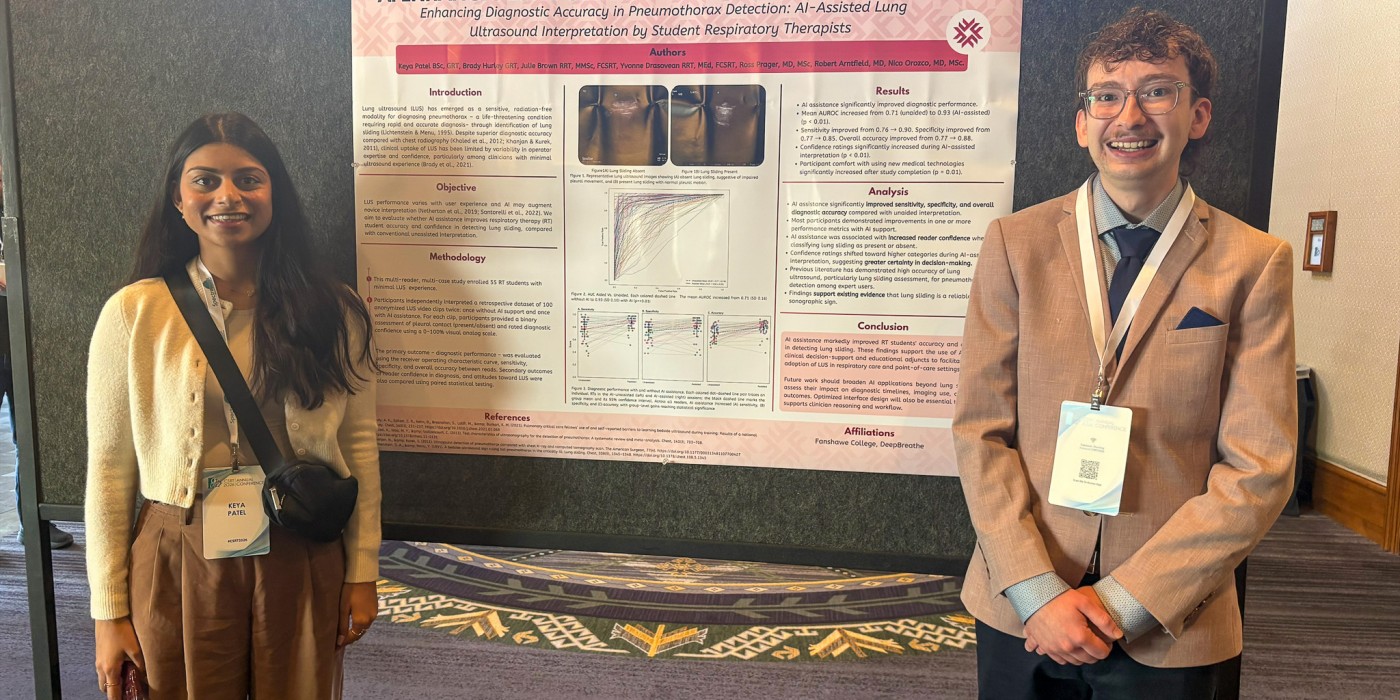
The study involved 55 Respiratory Therapy students, each completing 100 lung ultrasound interpretations without AI assistance and another 100 with AI support. Results demonstrated a significant improvement in diagnostic accuracy, sensitivity and overall confidence when AI-assisted technology was used.
"This project is a great example of how applied research can directly enhance both student learning and patient care," says Julie Brown, faculty and coordinator of the Respiratory Therapy program. "By evaluating AI-assisted interpretation of lung ultrasound, our students were exposed to emerging clinical technologies while contributing to research that has real relevance for rapid, high-stakes respiratory assessment. The significant improvement in diagnostic accuracy and confidence we observed highlights the potential of these tools to support clinicians at the bedside and ultimately improve patient outcomes."
Beyond the research findings, the project provided students with hands-on experience throughout the entire research process, including ethics approval, data collection, analysis and knowledge dissemination.
"The success of this study speaks to the strength of our Student–Faculty Research Committee," says Brown. "Students are involved in every stage of the research process, from ethics and data collection to analysis and national presentation, which is an invaluable learning experience. Collaborations with partners at the University of Waterloo and London Health Sciences Centre allow our students to work alongside engineers and physicians, reinforcing Fanshawe's leadership in interprofessional, innovation-driven respiratory care research."
Respiratory Therapy students Brady Hurley and Keya Patel presented the research findings at the Canadian Society of Respiratory Therapists (CSRT) National Forum in May. Brady delivered an oral presentation while Keya presented the research poster, representing Fanshawe alongside respiratory therapy professionals, researchers and educators from across Canada.
According to Brown, the presentation received positive feedback from conference attendees who praised both the quality of the research and the professionalism demonstrated by the students.
“(Brady and Keya) had many attendees from all over Canada compliment them after on their work and presentation,” she says. “We had many healthcare professionals mention how amazing our students were and what great things this student-faculty research committee is doing for the profession.”
Recent News
-
October 14, 2026
Fanshawe College opens the WSIB Centre of Excellence in Immersive Technologies Simulation for Workplace Safety
Read Full ReleaseState-of-the-art facility will leverage XR and AI to advance workplace safety, training and mental... -
October 13, 2026
Temporary Richmond Street closure for rail crossing repairs
Read StoryCPKC Rail is completing repairs to the railway crossing on Richmond Street. Richmond Street will be... -
October 5, 2026
Pant sale at The Falcon Shop
Read StoryThe Falcon Shop will hold a pant sale from October 5 to 30. All regularly priced pants (including...
Recent News
-
May 8, 2025
Construction Delays
Read StoryDue to ongoing construction in the area, there may be delays in reaching our clinic. We kindly ask... -
April 15, 2025
New Spring Schedule
Read StoryWe’re excited to announce that the spring schedule is now available on our website as we transition... -
December 16, 2024
2025 Pricing Adjustment
Read StoryEffective January 1st, our fees will increase to $30 per treatment. We understand that this is a...