
As President Devlin states in the EDI Strategic Action Plan, “belonging is at the core of Fanshawe’s mission to unlock potential.” Fanshawe is committed to advancing the work of reconciliation, creating inclusive, tolerant learning spaces, and making space for all students to belong within our community.
CEDI
The Centre for Equity, Diversity, and Inclusion (CEDI) is a team of people who work at Fanshawe to advance a sense of belonging for equity-deserving students and commit to addressing and dismantling oppression experienced by racialized persons; Indigenous communities; persons with disabilities; members of the 2SLGBTQIA+ community; and women. They also work with allies on campus, regardless of identity.
The CEDI website (login required) contains practical help for profs, such as a pronoun guide, list of definitions and resources, and information about Pride at Fanshawe.
EDI and Anti-Oppression Task Force
The college also hosts an EDI and Anti-Oppression Task Force consisting of students, faculty, support staff, and CEDI team members. A list of Task Force members can be found on the CEDI website. If you’re interested in getting involved in the Task Force or other CEDI events, please email edi@fanshawec.ca.
EDI in the Classroom
There are various ways you can promote EDI in your classroom:
- Start by introducing yourself using your pronouns (See CEDI’s Pronoun Guide). Add your pronouns to your Outlook signature, Teams account, and Zoom name.
- Get to know your students! Learn their preferred names as well as pronouns and use them throughout class.
- Start the term with a personalized land acknowledgment to situate yourself and your classes within the First Nations territory of this area.
- Ask about any religious or cultural celebrations that are happening throughout the term.
- Acknowledge yourself as a safe person who students can talk to assist them in finding people or services throughout the College.
- Acknowledge the power dynamics at play in the classroom.
- Solicit feedback throughout the term and be open to change based on the response.
- Allow students to demonstrate their knowledge or skills using a variety of assessment types.
EDI in the Curriculum
You can also incorporate EDI in your teaching materials. Here are a few examples:
- Examine your content to ensure diverse representation in photos, authorship, and content.
- Be mindful of your own biases and stereotypes when creating content.
- Consider how to best integrate Essential Employability Skill #8 (show respect for the diverse opinions, values, belief systems, and contributions of others) in your course content and assessments.
- Consider adding a Course Learning Outcome to your Course Outline that encompasses the principles of equity, diversity, and inclusion.
- Include authentic assessments where students can incorporate their lived experiences and perspectives.
FNMI (First Nations, Metis, and Inuit): Indigenous Learning and Decolonization
Decolonizing education doesn’t require a sense of shame or guilt; it begins with the idea that history happens through a cultural lens. Our schools have been created around certain colonial or Eurocentric ways of thinking and doing and continue to value certain ways of learning over other ways in a hierarchical structure. Decolonizing education addresses colonial legacies in curriculum and pedagogy, power dynamics within the classroom and school systems, and institutional structures that favour a Eurocentric, assimilationist approach to learning. The Truth and Reconciliation Commission’s Calls to Action highlight the importance of education in reconciliation. Part of decolonizing education means that educators take the time to educate themselves about the history and legacy of residential schools in Canada, current realities of murdered and missing Indigenous women and children and impacts of the Indian Act, and what is involved in our local treaties, for example. Decolonizing education means learning and including more Indigenous knowledge and history in our thinking and ways of doing and acknowledging differing worldviews.
Image
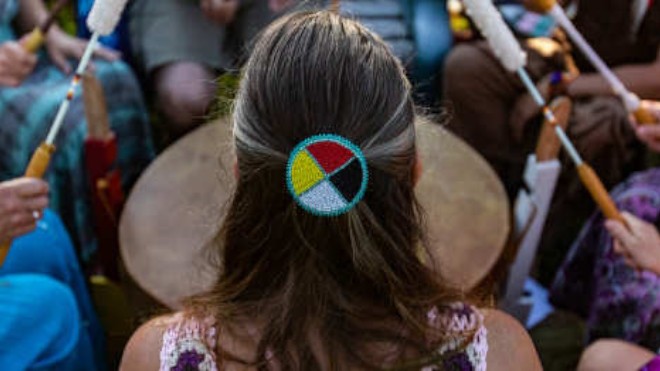
The Medicine Wheel is a sacred Indigenous symbol of health, balance, and the interconnectedness of all life, often depicted as a circle with four quadrants (commonly red, yellow, black, and white) representing the four directions, seasons, elements, and stages of life.
Institute of Indigenous Learning
The Institute of Indigenous Learning (IIL) is a welcoming, “home-away-from-home” space at Fanshawe College and is located in A1046. The IIL is a place for Status or Non-Status First Nations, Metis or Inuit to gather, connect, study, socialize, learn, relax, or be supported by friendly and knowledgeable staff. The IIL also puts on various events throughout the year for Indigenous and non-Indigenous folks. To learn more, please visit the Institute of Indigenous Learning website.
Culturally Responsive Teaching
Our classes at Fanshawe are filled with students from a variety of different cultural backgrounds. There are students from:
- rural and urban areas of Ontario
- international students from around the world
- Indigenous students from across Turtle Island
- newcomers to Canada
- students who have spent their whole lives in London, ON.
As an educator, it is important to know your students and learn how culture affects a student in the classroom. It is not possible to know about every culture, but it is important to have intercultural awareness. Culturally responsive teaching is a student-centred approach that acknowledges and embraces students’ cultures, languages, and lived experiences to help foster a sense of belonging. Culturally responsive teaching is rooted in principles of social justice, ensuring all students have equal opportunities to learn, regardless of their background.
EDI & FNMI Resources
General Resources
- Highway of Tears Documentary: https://highwayoftearsfilm.com/watch
A look at the disappearances and murders of Indigenous women and girls along Highway 16 in British Columbia. - GoodMinds Bookstore: https://goodminds.com/
A fantastic Indigenous-owned bookstore based out of Six Nations of the Grand River First Nation—a great way to support Indigenous organizations. - Iroqrafts: https://www.sixnationstourism.ca/art-studios-gift-shops/iroqrafts
The longest-running Indigenous arts and crafts store in Ontario, located in Six Nations. A great place to find authentic Haudenosaunee and other Indigenous-made items. - Starlight Tours: https://allthatsinteresting.com/starlight-tours
An article explaining the history of Starlight Tours, a disturbing practice where police officers in Canada abandoned Indigenous people in freezing conditions, leading to tragic deaths.
Books
- Berardo, K. and Deardorff, D. K. (2012). Building Cultural Competence: Innovative Activities and Models. Stylus Publishing.
- Downie, G. (2016). Secret Path. Simon and Schuster.
- Freire, P. (2017). Pedagogy of the oppressed. Penguin Classics.
- Hammond, Z. L. (2015). Culturally responsive teaching and the brain. Corwin Press.
- Joseph, B. (2018). 21 Things You May Not Know about the Indian Act: Helping Canadians Make Reconciliation with Indigenous Peoples a Reality. Indigenous Relations Press.
- Joseph, B. and Joseph, C.F. (2019) Indigenous Relations: Insights, Tips & Suggestions to Make Reconciliation a Reality. Indigenous Relations Press.
- Kimmerer, R. W. (2014). Braiding sweetgrass.
- Leddy, S. and Miller, L. (2024) Teaching Where You Are: Weaving Indigenous and Slow Principles and Pedagogies. University of Toronto Press.
- McDiarmid, J. (2020). Highway of Tears: A True Story of Racism, Indifference and the Pursuit of Justice for Missing and Murdered Indigenous Women and Girls. National Geographic Books.
- Roberts, C. (2024) Re-Storying Education: Decolonizing Your Practice Using a Critical Lens. Page Two Books, Inc.
- Toulouse, P. R. (2018) Truth and Reconciliation in Canadian Schools. Portage & Main Press.
- Zheng, L. (2023) DEI Deconstructed: Your No-Nonsense Guide to Doing the Work and Doing it Right. Berrett-Koehler Publishers, Inc.
Table