
Published
Tuesday, October 20 2026
Last Updated
Welcome to Spotlight, a new digital content series showcasing high-impact, good news stories from the Fanshawe community.
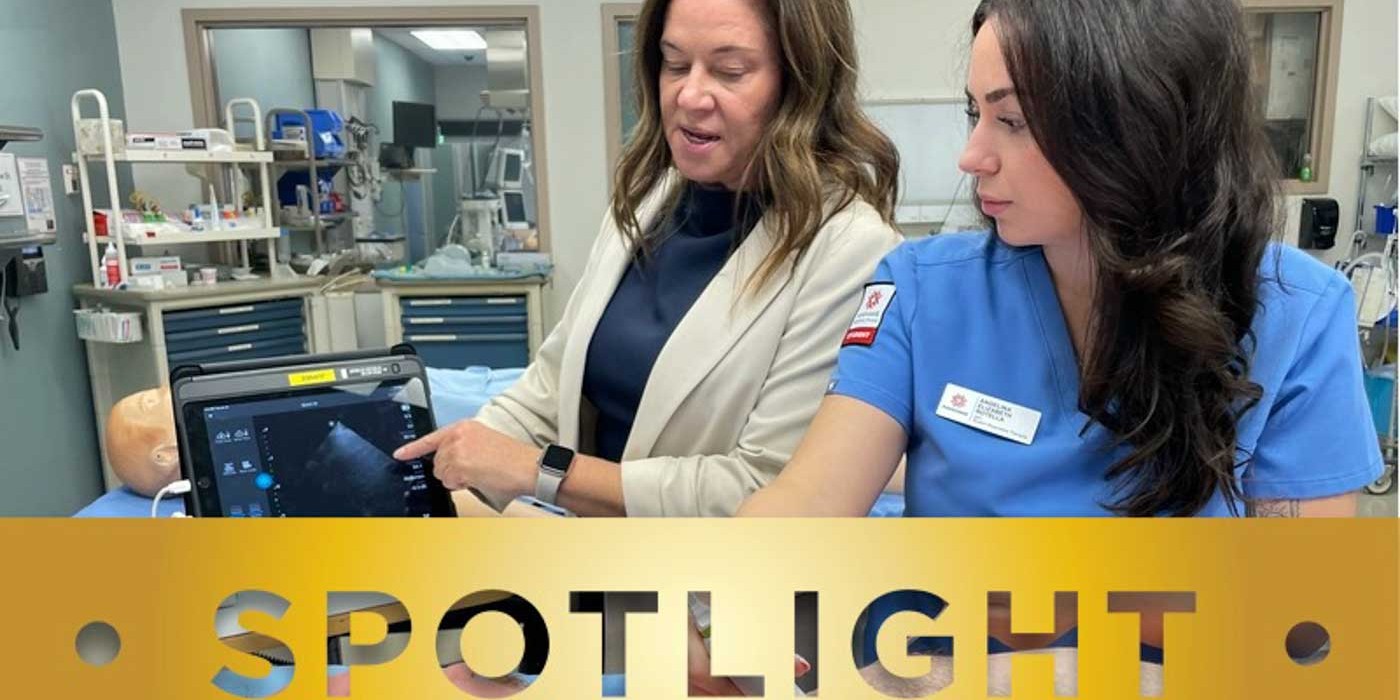
For Keya Patel, the impact of a research project she began as a student has taken on new meaning now that she is working as a registered respiratory therapist at William Osler Health System.
“It truly is a feeling like no other to be able to stand on both sides of innovation—both as a clinician who sees the challenges at the bedside and as a researcher contributing to potential solutions,” says Patel, a 2026 graduate of Fanshawe's Respiratory Therapy program.
Patel was one of 55 Respiratory Therapy students who participated in a multi-phase applied research project exploring whether artificial intelligence could help clinicians interpret lung ultrasound images more accurately and confidently.
The project, “Evaluating the Effectiveness of AI Assisted Technology for Detecting Lung Sliding on Lung Ultrasound,” examined the use of AI-assisted interpretation to identify lung sliding, an important indicator of a healthy lung.
Point-of-care lung ultrasound is increasingly used in emergency medicine because it can allow clinicians to rapidly assess serious and potentially life-threatening conditions at the bedside, often without waiting for traditional imaging such as X-rays or CT scans.
For Patel, the research had particular meaning because of what she has experienced in clinical practice.
“In my clinical practice, I have seen first-hand the consequences of suboptimal diagnostics, particularly in time-sensitive situations, which has given me a strong appreciation for the need to advance technology at the bedside,” she says.
Those experiences stayed with her throughout more than a year of working on the study and helped connect the research to the realities of patient care.
The first phase of the project, conducted in partnership with biotechnology engineering researchers at the University of Waterloo, evaluated a virtual reality training tool designed to teach students how to obtain accurate diagnostic images of the lungs.
The second phase, conducted in collaboration with physicians at London Health Sciences Centre, focused on clinical image interpretation. Students completed 100 lung ultrasound interpretations without AI assistance and another 100 with AI support.
The results showed significant improvements in diagnostic accuracy, sensitivity and overall confidence when AI-assisted technology was used.
“After more than a year of working on the study, seeing such promising results has been incredibly fulfilling,” says Patel. “What is especially exciting is recognizing the possibilities that extend beyond the study itself—the potential for this technology to improve diagnostic accuracy, support clinical decision-making, enhance patient safety, and ultimately contribute to better patient outcomes.”
The project also gave students an opportunity to experience research from beginning to end, including ethics approval, data collection, analysis and knowledge dissemination.
That hands-on experience is a key part of Fanshawe's Student–Faculty Research Committee, says Julie Brown, faculty and coordinator of the Respiratory Therapy program.
“This project is a great example of how applied research can directly enhance both student learning and patient care,” says Brown. “By evaluating AI-assisted interpretation of lung ultrasound, our students were exposed to emerging clinical technologies while contributing to research that has real relevance for rapid, high-stakes respiratory assessment.”
The experience continued beyond the research itself.
In May, Patel and fellow Respiratory Therapy student Brady Hurley presented the study's findings at the Canadian Society of Respiratory Therapists’ National Forum. Hurley delivered an oral presentation, while Patel presented the research poster, representing Fanshawe alongside respiratory therapy professionals, researchers and educators from across Canada.
Image
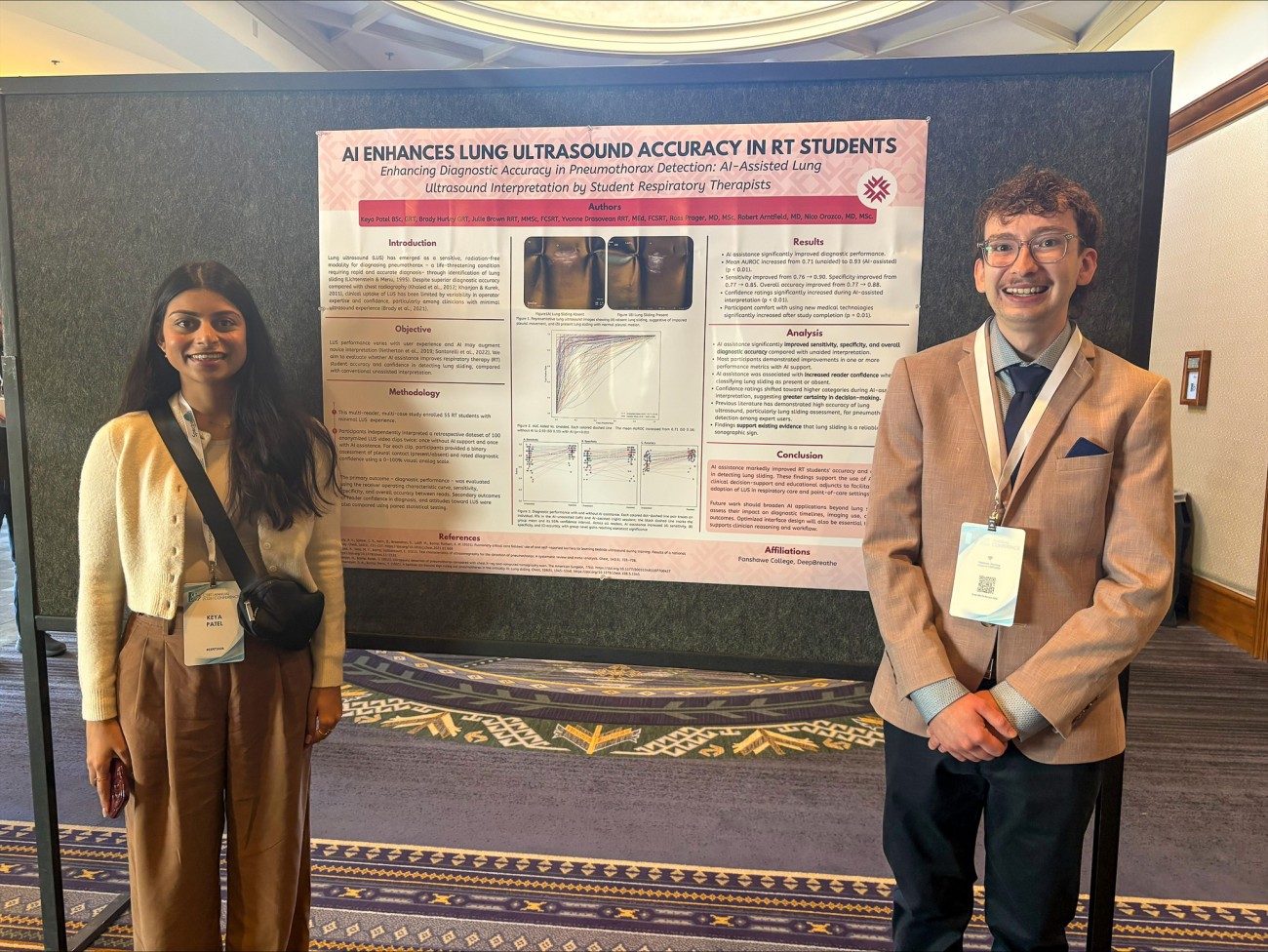
“It was a proud moment for us to showcase our findings and contribute to a community so dedicated to advancing respiratory therapy through research and innovation,” says Patel.
The experience represented an opportunity to contribute to the future of her profession while gaining a deeper understanding of how research can influence patient care.
The experience also encouraged her to pursue additional research opportunities and explore how respiratory therapists can play a greater role in advancing innovation and improving patient care.
“Being able to contribute to that kind of progress is incredibly meaningful,” she says.
For any media inquiries, please reach out to mediainquiries@fanshawec.ca
Recent News
-
October 20, 2026
Respiratory Therapy graduate helps explore AI’s potential to improve lung ultrasound diagnosis
ReadWelcome to Spotlight, a new digital content series showcasing high-impact, good news stories from... -
October 19, 2026
Chartwells food services - hours of operation for fall 2026
Read StoryBeginning September 8, 2026 Location Monday to Thursday Friday Starbucks 8 a.m. to 4 p.m. 8 a.m. to... -
October 18, 2026
Fanshawe College statement on tragedy at CFB Wainwright
Read StoryAs a Military-Connected College, Fanshawe College extends our deepest condolences to the families...
Recent News
-
May 8, 2025
Construction Delays
Read StoryDue to ongoing construction in the area, there may be delays in reaching our clinic. We kindly ask... -
April 15, 2025
New Spring Schedule
Read StoryWe’re excited to announce that the spring schedule is now available on our website as we transition... -
December 16, 2024
2025 Pricing Adjustment
Read StoryEffective January 1st, our fees will increase to $30 per treatment. We understand that this is a...