

Reading Time
4 minutes
Published
Tuesday, November 24, 2026
Last Updated
Careers in policing and security are in demand, with opportunities expanding across a variety of fields, including law enforcement, cybersecurity, corrections, investigative techniques and border security. As the industry evolves and new challenges emerge, colleges like Fanshawe are preparing students with the knowledge and practical skills needed to pursue careers in these areas.
Fanshawe College is committed to providing relevant, hands-on education that responds to the changing needs of the public safety and security sectors. It offers two diploma programs for students interested in policing, law enforcement and public security:
| Policing and Community Safety (previously Police Foundations) | Protection, Security and Investigation |
How do the two programs differ?
Both diploma programs are two years in length and combine theoretical learning with practical, hands-on experiences. In fact, both programs share the same first level of courses. As you progress through your studies, however, the programs take different directions.
Policing and Community Safety focuses more specifically on law enforcement, police powers, community policing and investigations. It's designed for students interested in understanding the role of policing and developing the knowledge and skills associated with public safety and law enforcement.
Protection, Security and Investigation offers a broader focus on public and private security, law enforcement and public safety. It explores different areas of the security sector and provides a foundation for students interested in a variety of investigative and protective services careers, corrections and border security.
Here's a quick overview of how the two programs compare (as of 2026):
Policing and Community Safety | Protection, Security and Investigation | |
Duration | 2 years | 2 years |
Cost | $7,297 (domestic) | $7,192 (domestic) |
Admission Requirements | Grade 12 English (C) with a minimum final grade of 70%, or Grade 12 English (U) with a minimum final grade of 60% | Grade 12 English (U), or Grade 12 English (C) with a minimum final grade of 60% |
Recommended Courses | Grade 12 Challenge and Change in Society (U) Grade 12 Canadian and International Law (U) OR Grade 11 Understanding Canadian Law (U/C) Grade 12 Personal and Fitness Activities (O) | |
Post-admission Requirements | First Aid, CPR and AED Certification | First Aid, CPR and AED Certification |
Both programs have similar admission requirements, although the Policing and Community Safety Diploma has a slightly higher benchmark for written and verbal skills. Students in both programs are also expected to maintain a high level of fitness through mandatory physical training and fitness classes.
In addition, both programs incorporate scenario-based learning and role-playing exercises, giving students opportunities to apply their theoretical knowledge to realistic situations.
Future Opportunities and Possibilities for Transfers
While the two programs have different areas of focus, there may be some flexibility if your interests change as you progress through your studies.
After completing their first level of the course, students have the option to transfer between the two programs provided they meet eligibility requirements, have good academic standing, and there are seats available.
Both programs also provide a foundation for further education in fields such as criminology, political science, justice studies and forensic psychology at Canadian colleges and universities.
Find more information on Pathways and Credit Transfer here.
Image
Career Options
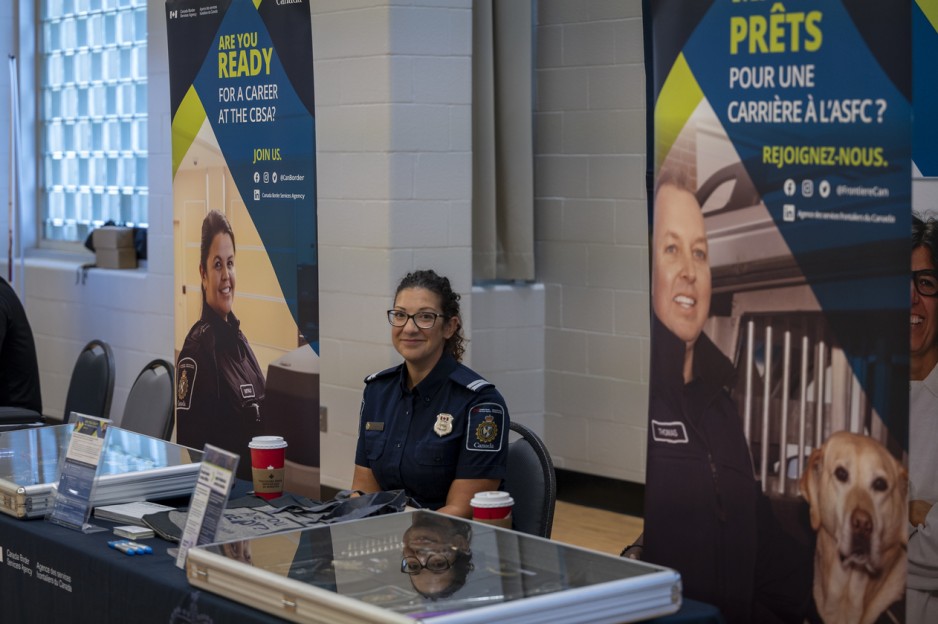
It's important to remember that completing either diploma does not automatically qualify you for employment with a police service or in another regulated occupation. Additional training, testing, certifications or other hiring requirements may apply, depending on the career. However, the knowledge and practical experience gained through either program can help prepare you to pursue opportunities in the field.
Some potential career paths include:
- Police Constable
- RCMP Officer
- Loss Prevention Officer
- Security Guard
- Border Services Officer
- Correctional Officer
Over the next year, the Government of Canada predicts moderate to very good demand for the above roles, with average wages ranging from $36.15/hour for Correctional Officers to $50/hour for Police Officers.
Which Diploma should you choose?
Ultimately, the right program depends on your interests and career goals.
If you're particularly interested in becoming a police officer and want to focus your studies on policing, law enforcement and community safety, the Policing and Community Safety Diploma may be the right fit.
If you're interested in exploring a wider range of opportunities in public and private security, investigations, border security and protective services, the Protection, Security and Investigation Diploma offers a broader introduction to the field.
Still unsure? The Protection, Security and Investigation Diploma may offer a starting point for students who want to explore different areas of law and security before deciding whether to pursue a more specific focus in policing. Students may also have the opportunity to transfer into Policing and Community Safety, subject to eligibility and academic standing.
Not sure which program is right for you? Book an appointment with one of Fanshawe's Recruitment Officers. They can answer your questions, help you explore your options and find the program that best aligns with your interests and career goals!
Related Blog Posts
Image

What Jobs can you get with a Diploma?
November 3, 2026
The job market in today’s world is unlike any other. As jobs constantly evolve, they demand a unique set of skills and strategies from job seekers. In Canada, more and more...
Image
Which Pre-Health Sciences Pathway Program is best for you?
October 1, 2026
Choosing the right post-secondary program can feel overwhelming, especially if you’re interested in healthcare but aren’t sure which career path within health sciences is right for...
Image
How to Redesign Your Backyard | Step-by-Step Landscape Design Guide
May 13, 2026
Learn how to redesign your backyard with this step-by-step guide. Discover landscape design tips, planning strategies, and expert advice for beginners.
View Blog Post