
Published
Wednesday, October 21 2026
Last Updated
As Fanshawe looks toward 2035, our leaders will share their perspectives on the issues that matter. This series explores the opportunities, challenges and innovations shaping the future of education, workforce development and our community.
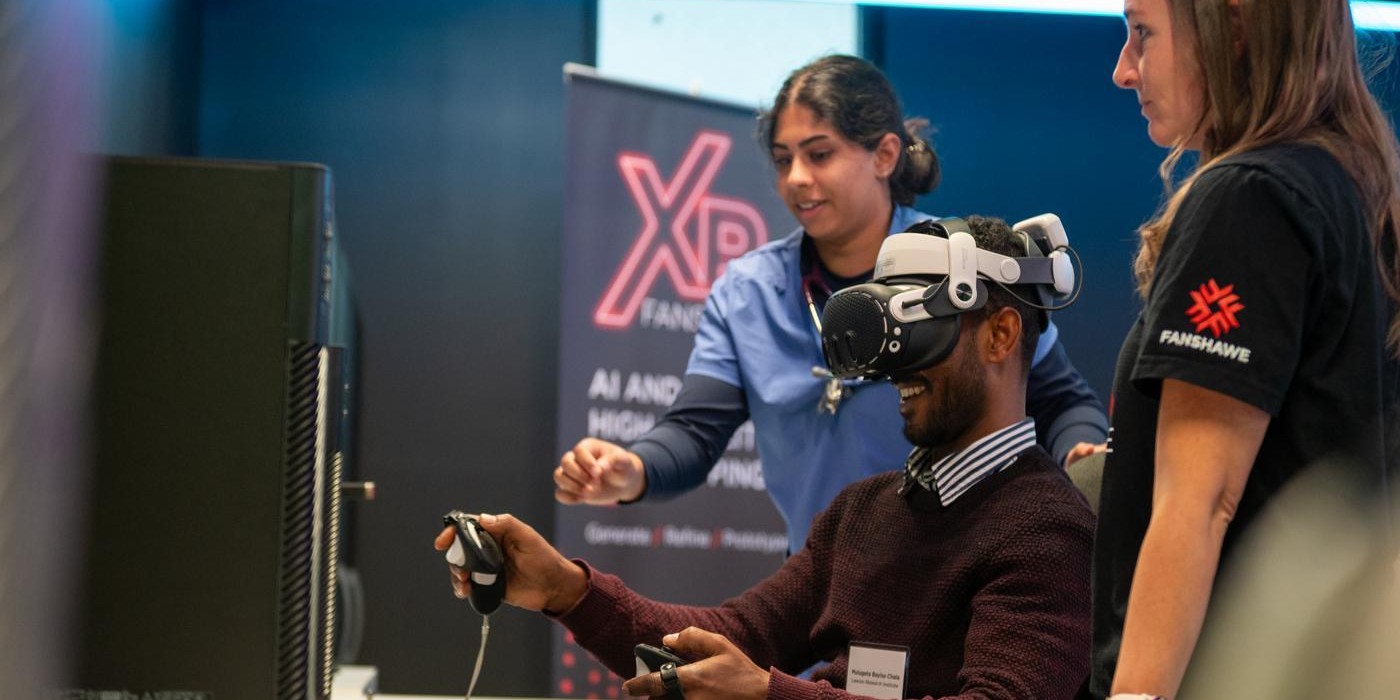
At Fanshawe College, one of our three areas of strategic focus is “making a difference for stronger contributions to our community and the economy”. We endeavor to do so through collaborations with strategic partners and employers in ways that embolden experiential education for our students. Such was the case when the College recently worked collaboratively with the public safety sector and the WSIB to develop and launch the new WSIB Centre of Excellence in Immersive Technologies Simulation for Workplace Safety.
Image
Complex challenges require collaborative solutions. That’s why, at Fanshawe College, our education leaders meet regularly with industry and not-for-profit leaders to clearly understand their needs and to co-develop creative, innovative solutions together.
Such was the case when the leaders from the first responder sector (police, fire, paramedicine, and corrections) were canvassed two years ago by Fanshawe’s Corporate Training Solutions (CTS). At the time, three very important themes were identified that were consistent across the four public safety groups. Each described challenges tied to the attrition of new recruits, who, once in the field, quickly determined that the nature of the work was not as they had imagined. Each also described an inability – by virtue of cost, complexity and risk, to create physical training environments capable of mimicking real-world, high-risk environments. Each also described a much higher than average number of mental stress injuries related claims tied to cumulative exposure to human suffering, violence and death. It was through these discussions and then through the collaborative ideation and problem-solving that followed, that AI enabled extended reality (XR) simulation as a solution was born.
Co-created simulation was viewed to be an affordable, flexible and practical way for first responders to practice their response to a high-risk situation – and to allow them to fail as many times as necessary – with no real harm caused. Through repetitive engagement with simulation, mastery will eventually follow. While this solution was seen as a fit for preventative training, the same AI enabled XR simulation technology was also viewed to be an efficient and effective tool to provide clinical support to responders experiencing mental stress injury. Cognitive-behavioural simulation can reduce barriers and stigma related to seeking therapy, enhance the effectiveness of in-person treatment, and provide interim support for injured individuals who are awaiting services or have limited access to care, such as those living in rural communities.
Problems as complicated as these are rarely managed without a host of other partners also being engaged along the way. The WSIB has funded the development of a physical production and research AI/XR simulation ecosystem at Fanshawe inclusive of: simulation labs; 3D simulation rooms; motion capture and biomechanics systems; XR laboratories and an XR content creation studio. The organization also remains steadfast in its support for the operational sustainability of the initiative. Central to the ecosystem’s success were Fanshawe’s students and faculty, whose support was indispensable in bringing this vision to life.
Drawing on the expertise of students and faculty across disciplines ranging from information technology and AI to public safety, health sciences, creative media, business, and applied research, the initiative will create, test, and refine training and clinical simulation assets designed to benefit first responders across the region and the country.
Not only will the students benefit from an experiential opportunity tied to their technical area of focus, but they will leave such project work and enter the modern workforce with the invaluable soft skill of multi-disciplinary collaboration and innovation.
Now that the foundational AI/XR simulation ecosystem at Fanshawe has been firmly established, scaling to other economic priority sectors such as construction, advanced manufacturing, and transportation are inevitable, thereby multiplying social and economic impact in our communities whilst providing an even greater number of students, across an even greater number of disciplines, the opportunity to develop and master multi-disciplinary collaboration and innovation skills.
For any media inquiries, please reach out to mediainquiries@fanshawec.ca
Recent News
-
October 21, 2026
Complex challenges require collaborative solutions
Read OpinionAs Fanshawe looks toward 2035, our leaders will share their perspectives on the issues that matter... -
October 20, 2026
Fanshawe faculty and alumni help inspire future green industry professionals
Read StoryFaculty, staff and alumni from Fanshawe’s Horticulture Technician program volunteered a Saturday in... -
October 20, 2026
Respiratory Therapy graduate helps explore AI’s potential to improve lung ultrasound diagnosis
ReadWelcome to Spotlight, a new digital content series showcasing high-impact, good news stories from...
Recent News
-
May 8, 2025
Construction Delays
Read StoryDue to ongoing construction in the area, there may be delays in reaching our clinic. We kindly ask... -
April 15, 2025
New Spring Schedule
Read StoryWe’re excited to announce that the spring schedule is now available on our website as we transition... -
December 16, 2024
2025 Pricing Adjustment
Read StoryEffective January 1st, our fees will increase to $30 per treatment. We understand that this is a...