
Published
Monday, May 11 2026
Last Updated
An interview with Claudio Mastroianni, Program Coordinator, Welding and Fabrication Technician Program
Becoming an underwater welder sounds exciting and it is, but it is also one of the most demanding and high-risk paths in the welding trade.
What is underwater welding?
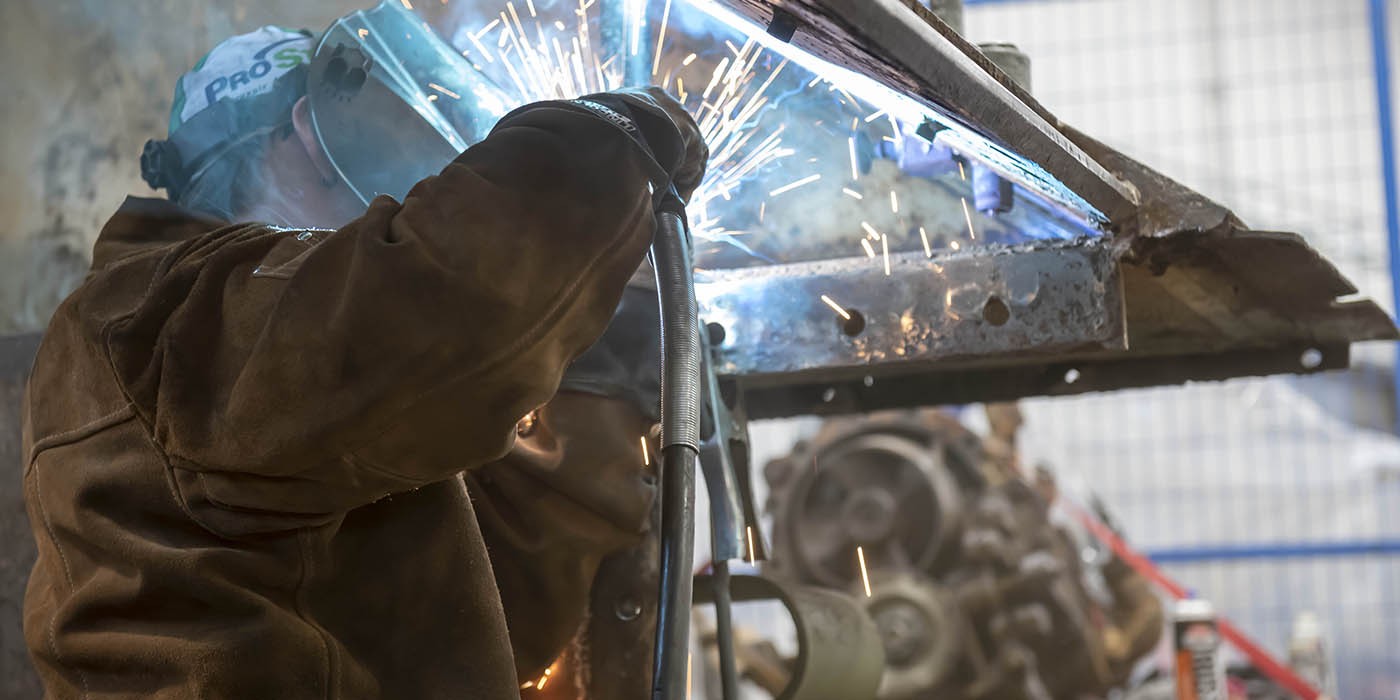
Underwater welding, also known as hyperbaric welding, involves performing welding tasks below the surface of the water. It is commonly used for: repairing ships, maintaining offshore oil rigs and supporting underwater construction. Welding underwater requires specialized equipment and techniques to manage pressure, visibility and safety.
Underwater welding is not an entry-level role. “You cannot go to school and say you want to be an underwater welder. You should have at least ten or fifteen years of experience welding on the ground first.” Before working underwater, welders build years of experience using standard welding processes. This foundation is essential before moving into specialized environments like hyperbaric welding.
You need both diving and welding expertise
Underwater welding combines two skill sets.
First: you must become a commercial diver. Commercial diving training includes:
- Dive theory
- Equipment operation
- Hazard awareness
- Emergency response
- Physical conditioning
Second: you must be a skilled welder.
Most underwater welders begin with years of topside experience, often using stick welding. Most underwater welding relies on stick welding (SMAW), a process suited to field conditions because it does not require external shielding gas.
What the work environment looks like
Underwater welding takes place in demanding conditions. In many situations, welders rely on touch rather than sight to complete their work.
Common job sites include: oil rigs, bridge foundations and underwater construction structures.
Work often involves: limited visibility, strong currents, cold water, confined spaces
The risks of underwater welding
Welding underwater comes with serious risks electric shock, poor visibility, hydrogen embrittlement and physical strain. Hydrogen embrittlement can make metal brittle, increasing the risk of structural failure if procedures are not followed carefully. Because of these risks, safety and precision are critical in every task.
A physically demanding career path
Becoming an underwater welder is not a quick path. It requires years of training, hands-on experience and a strong understanding of both welding and diving. Underwater welding is a specialized career built over time, requiring strong welding fundamentals, commercial diving certification, physical endurance and the ability to manage risk in challenging environments.
For most people, the path starts on the ground. Building experience in standard welding processes creates the foundation needed for advanced opportunities like hyperbaric welding.
Underwater welding is also physically demanding and is not typically considered a long-term role.
“You cannot do it for many years. I would say around ten or fifteen years. It takes a toll on your body.”
Many professionals eventually move into supervisory roles or return to topside welding work after gaining experience underwater.
For those willing to put in the time and preparation, underwater welding offers a unique and highly specialized career path. It is a profession that demands respect, discipline and skill at every stage.
This article was developed by Trong Truong Son Vu, Honours Bachelor of Commerce - Digital Marketing (Co-op) student. Brought to you in collaboration with Village Creative, an experiential learning opportunity at Fanshawe College.
For any media inquiries, please reach out to mediainquiries@fanshawec.ca
Recent News
-
October 23, 2026
Poppies available starting October 24
Read StoryOn October 24, Canadians are encouraged to start wearing poppies in honour of our veterans and... -
October 22, 2026
Temporary service interruptions related to the global PHP outage
Read StoryAs many organizations around the world continue to respond to what is becoming known as the "PHP... -
October 22, 2026
Dell Top Tech sale, October 2026
Read StorySavings for Fanshawe students and employees Looking for a new laptop, monitor or desktop? Dell...
Recent News
-
May 8, 2025
Construction Delays
Read StoryDue to ongoing construction in the area, there may be delays in reaching our clinic. We kindly ask... -
April 15, 2025
New Spring Schedule
Read StoryWe’re excited to announce that the spring schedule is now available on our website as we transition... -
December 16, 2024
2025 Pricing Adjustment
Read StoryEffective January 1st, our fees will increase to $30 per treatment. We understand that this is a...