

Published
Monday, May 11 2026
Last Updated
An interview with Claudio Mastroianni, Program Coordinator, Welding and Fabrication Technician Program
Welding is changing. What was once a manual, labour-intensive trade is becoming more precise, more efficient and increasingly supported by technology. These changes are reshaping how welding is performed across industries, from manufacturing to construction and energy.
The foundation of welding still matters
Even as welding evolves, the fundamentals remain the same. Processes like MIG welding, TIG welding and stick welding are still widely used and form the starting point for most welders. These methods build the core skills needed to work with different materials and environments.
Modern welding technologies build on that foundation rather than replace it.
Improving efficiency in welding
One of the biggest changes in modern welding is efficiency. Newer power sources, such as inverter-based machines, use less energy while maintaining consistent performance. This reduces electricity use without sacrificing weld quality. Cleaner shielding gas mixtures also contribute by supporting stable welds and reducing emissions during the process.
Reducing waste and rework
Efficiency is not only about speed. It is also about reducing waste. Low spatter processes create less excess material, which reduces grinding, cleanup and consumable use. Automation also helps reduce rework by keeping welds within set parameters. “Minimize waste and rework and use a more energy efficient joining method.”
Welding automation and robotics
Automation is becoming more common across the trade. Robotic welding systems improve consistency and output, especially in manufacturing and fabrication environments. Cobots, or collaborative robots, are making automation more accessible. They allow smaller operations to adopt robotic welding without large-scale setups. “Robotics and automated welding systems are improving consistently and are very productive.”
Digital tools in modern welding
Digital systems are changing how welding is monitored and managed. Cloud-based platforms allow for quality tracking, remote inspection and parameter monitoring. This makes it possible to review weld performance without being physically on site. These tools improve accuracy and reduce the likelihood of defects.
Training with simulation and augmented reality
Image
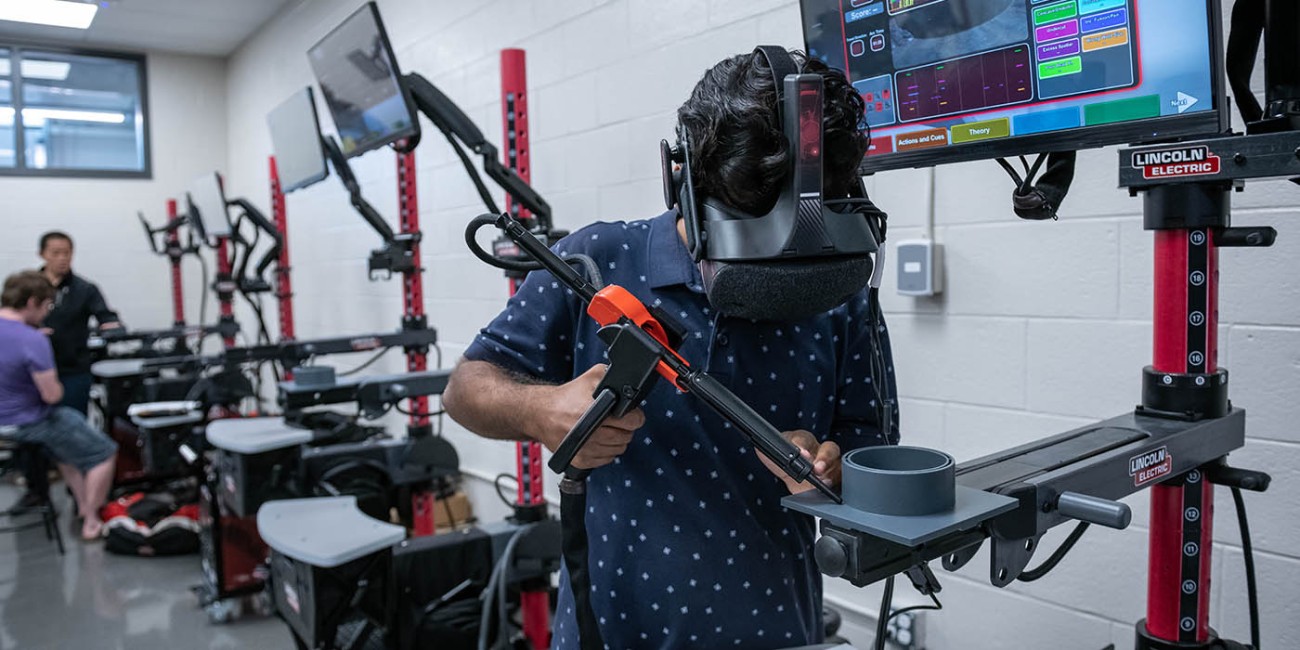
Training methods are also evolving. Augmented reality simulators allow students to practice torch movement, travel speed and positioning
without using real materials. Because no metal, gas or filler is consumed, simulation reduces waste while helping build skill before working with live equipment.
Artificial intelligence in welding
Artificial intelligence is beginning to play a role in welding. “AI and machine learning optimize parameters and predict defects.”
These systems can adjust settings automatically, improve consistency and reduce errors, which leads to better weld quality and less wasted material.
What this means for the future of welding
Welding is becoming more precise, more efficient and more technology-driven. Automation, digital tools and AI are changing how welders work and what skills they need. For those entering the trade, this means learning more than technique. It means understanding how to work with modern systems that are shaping the future of welding.
This article was developed by Trong Truong Son Vu, Honours Bachelor of Commerce - Digital Marketing (Co-op) student. Brought to you in collaboration with Village Creative, an experiential learning opportunity at Fanshawe College.
For any media inquiries, please reach out to mediainquiries@fanshawec.ca
Recent News
-
October 23, 2026
Poppies available starting October 24
Read StoryOn October 24, Canadians are encouraged to start wearing poppies in honour of our veterans and... -
October 22, 2026
Temporary service interruptions related to the global PHP outage
Read StoryAs many organizations around the world continue to respond to what is becoming known as the "PHP... -
October 22, 2026
Dell Top Tech sale, October 2026
Read StorySavings for Fanshawe students and employees Looking for a new laptop, monitor or desktop? Dell...
Recent News
-
May 8, 2025
Construction Delays
Read StoryDue to ongoing construction in the area, there may be delays in reaching our clinic. We kindly ask... -
April 15, 2025
New Spring Schedule
Read StoryWe’re excited to announce that the spring schedule is now available on our website as we transition... -
December 16, 2024
2025 Pricing Adjustment
Read StoryEffective January 1st, our fees will increase to $30 per treatment. We understand that this is a...