Since October 2024, Fanshawe College has been leading a regional initiative funded in part by the Government of Canada’s Sustainable Development Goals Funding Program to advance local implementation and measurement of the United Nations Sustainable Development Goals (SDGs).
Project Summary
The project supports municipalities, nonprofits, businesses, and educational institutions across the London economic region in contributing to Canada’s 2030 Agenda. Through research, community engagement, and cross-sector collaboration — with a strong emphasis on equity-deserving voices — the initiative is developing practical SDG Implementation and Measurement Guidelines tailored to local realities.
The project includes:
- A province-wide municipal survey (60 responses)
- 15 semi-structured interviews with community leaders
- Local focus groups identifying barriers and opportunities
The resulting guidelines focus on strengthening collaboration, embedding equity-centered engagement, and improving data management and reporting practices. The project will continue through September 2026, with knowledge-sharing activities including a public dissemination event and national outreach.
Partner Organizations
This initiative is delivered in collaboration with key regional partners:
- City of London
- City of St. Thomas
- Elgin Middlesex Oxford Workforce Planning & Development Board
The project is further strengthened by a diverse working group representing municipal leaders, post-secondary institutions, Indigenous communities, school boards, non-profits, and industry partners. In addition to our regional partners, contributing organizations include:
- Western University
- All Women L.E.A.D.
- London Economic Development Corporation
- Chippewas of the Thames First Nation
- The Salvation Army
- Fanshawe College’s Centre for Equity, Diversity and Inclusion
- Northwest London Resource Centre
- Muslim Resource Centre for Social Support and Integration
- Proof Line Farm
- The London Cross-Cultural Learner Centre
Together, these partners are helping build a more sustainable, inclusive, resilient, and prosperous region by translating global goals into meaningful local action.
The Challenge
While momentum toward the United Nations Sustainable Development Goals (SDGs) is growing across Canada, local adoption and implementation remain limited. Organizations often struggle to translate the global 2030 Agenda into meaningful, measurable local action.
Research conducted by Fanshawe College revealed common barriers:
- Difficulty localizing SDG targets to fit community realities
- Limited alignment between organizational priorities and specific goals
- Challenges integrating SDG indicators into existing evaluation systems
- Gaps in collaboration and data management
Without practical guidance tailored to local contexts, municipalities, non-profits, companies, and educational institutions face obstacles in contributing effectively to Canada’s 2030 Agenda.
The Solution
Since October 2024, Fanshawe College has been leading a multi-phase project, funded in part by the Government of Canada’s Sustainable Development Goals Funding Program, to strengthen local implementation and measurement of the SDGs across the London economic region.
Through research and deep community engagement, the project:
- Conducted a province-wide municipal survey (60 responses)
- Led 15 semi-structured interviews with leaders from London and St. Thomas organizations
- Facilitated focus groups with community representatives, prioritizing equity-deserving voices
Findings are being consolidated into a practical SDG Implementation and Measurement Guidelines resource designed to support organizations at any stage of their sustainability journey.
The guidelines focus on three critical areas:
- Collaboration
Strengthening internal coordination and cross-sector partnerships to advance shared SDG priorities. - Equity-Centered Engagement
Ensuring meaningful participation of equity-deserving groups in every stage of SDG-related initiatives. - Data Management and Measurement
Improving data collection, evaluation, reporting, and resource allocation practices to enhance transparency and impact.
The project is delivered in partnership with the City of London, City of St. Thomas, and the Elgin Middlesex Oxford Workforce Planning & Development Board, alongside a diverse working group representing municipalities, post-secondary institutions, Indigenous communities, school boards, non-profits, and industry leaders.
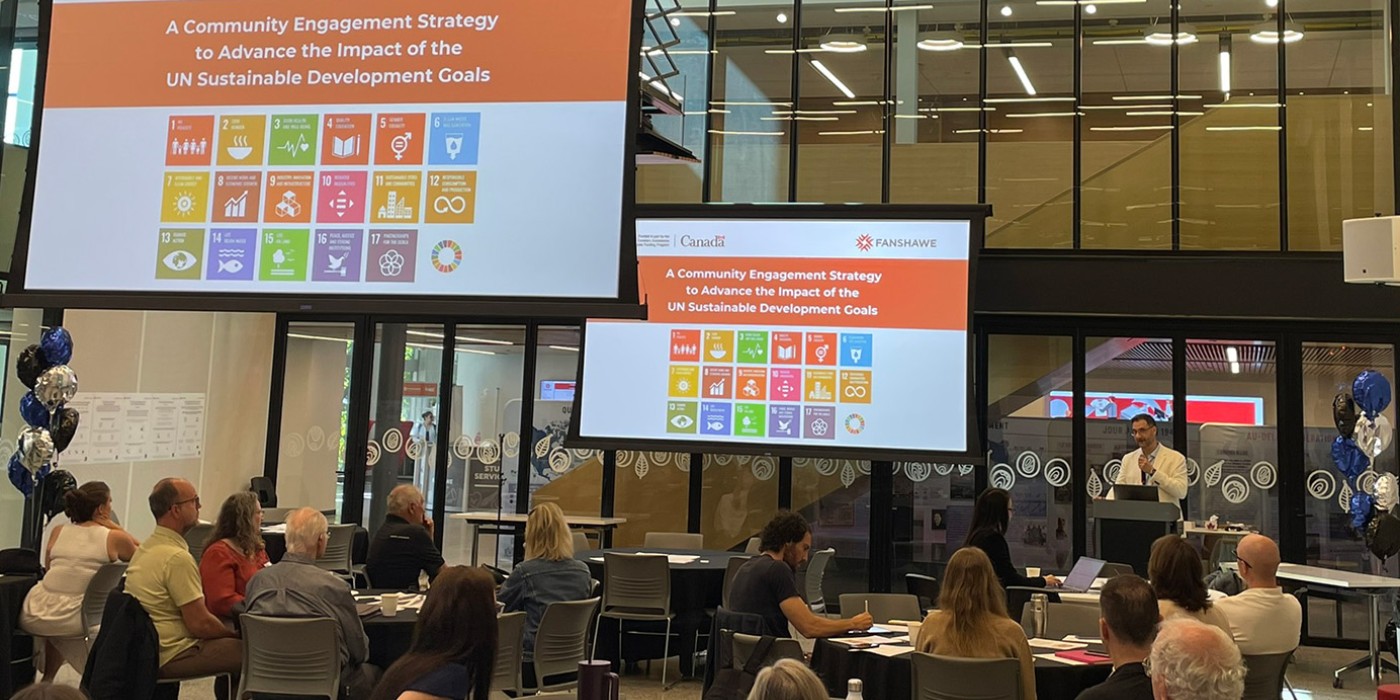
The initiative will unfold through September 2026. A final public dissemination event will be held on June 2, 2026 to launch and share the completed SDG implementation tool for community-wide use. Organizations and community members interested in attending can now register through the event webpage.
Project publications and additional information can be accessed through Open Library project page.
The Experience
The project has fostered meaningful cross-sector dialogue and strengthened partnerships across the region. High-quality collaboration, thoughtful analysis from community partners, and first-hand examples of local SDG action have reinforced the region’s commitment to building a more sustainable, inclusive, resilient, and prosperous future.
By creating practical, locally grounded guidance, Fanshawe College is helping translate the global 2030 Agenda into measurable community impact.

Related Case Studies