
Published
Wednesday, October 29 2025
Last Updated
Image
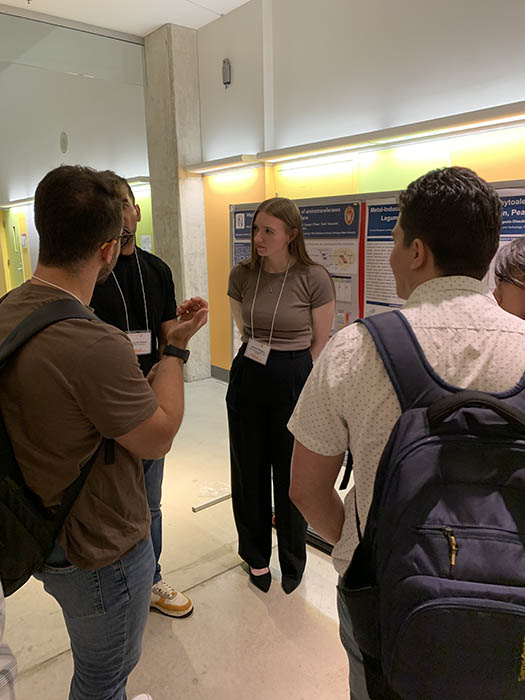
Allison Bergen had the professional opportunity of a lifetime when she presented her team’s research at the Annual Conference of the Phytochemical Society of North America (PSNA) in Toronto.
Bergen, a Chemical Laboratory Technician student, presented a poster about her team’s research entitled, “Metal-Induced Activation of Isoflavonoids and Phytoalexin Pathways in Legumes: Comparative Analysis of Soybean, Pea, and Lentil,” which examines the protection of lentils from disease.
A poster presentation is a visual, concise summary of research presented on a large poster board, to researchers. It’s also an opportunity to answer questions and get feedback from them.
Attending the conference pushed Bergen’s comfort zone, but it was worth the effort. She said receiving feedback from other researchers, professors and students gave her new perspectives as well as new ideas for the project.
“It was all around nerve-wracking and exciting and I'm very proud of the work I did and how I performed during the presentation,” Bergen said. “I’m now convinced that research is a possible career path.”
Helping lentils fight disease
Bergen’s team examined the defences lentils produce, which protects them from pests, pathogens and environmental stress. Increasing natural defences provides benefits for everyone. First, plants are healthier and produce higher crop yields. In addition, farmers benefit from improved profitability while the environment benefits from reduced chemical use. Finally, consumers get safer, high-quality produce.
Building upon previous studies that showed metal compounds, such as copper chloride, silver nitrate and copper sulfate, increase the defenses in soybean and peas, the team focused on whether compounds in lentils are related to the compounds in soybeans and peas. Using Liquid Chromatography mass spectroscopy – a technique that identifies and analyzes compounds – they compared these legume crops. They found when soybeans were treated with silver nitrate, the defense compound 'Glyceollin' increases and when peas were treated with copper compounds, the defense compound 'Pisatin' also increases.
While the research looks promising, more study is needed, Bergen said.
“The next step for this research is to look more into the compounds in lentils to possibly create defense compounds for them.”
Poster presentation a team effort
As part of her program at Fanshawe College, Bergen had a co-operative work term placement at Agriculture and Agri-Food Canada and she credits these researchers for providing guidance throughout the project and with the poster. They explained certain parts of the data, helped with the statistics and gave their opinion on how to improve the poster, she said.
As a result of their recommendations, she made changes, repeated experiments, analyzed data and researched different methods to gather all the information into one poster.
The researchers involved in producing the research are supervisor and Research Scientist at Agriculture and Agri-Food Canada, and adjunct professor at Western University Sangeeta Dhaubhadel, doctoral student Hodan Halane, lab technician Tim McDowell and chemist Justin Renaud.
The PSNA is a nonprofit scientific organization whose membership is open to anyone with an interest in phytochemistry and the role of plant substances in related fields.
They encourage and stimulate research on the chemistry and biochemistry of plant constituents, their effects upon plant and animal physiology and pathology, and their industrial importance and utilization.
Interested in learning more about Chemical Laboratory Technology?
Recent News
-
October 5, 2026
Pant sale at The Falcon Shop
Read StoryThe Falcon Shop will hold a pant sale from October 5 to 30. All regularly priced pants (including... -
October 5, 2026
Find support for mental health, accessibility, housing and more
Read StoryThe Student Well-Being team is excited to welcome you (or welcome you back) to Fanshawe College! As... -
October 2, 2026
The Royal Canadian Air Force partners with Fanshawe College to deliver training
Read Full ReleaseThe Royal Canadian Air Force (RCAF) has partnered with Fanshawe College to deliver aviation...
Recent News
-
May 8, 2025
Construction Delays
Read StoryDue to ongoing construction in the area, there may be delays in reaching our clinic. We kindly ask... -
April 15, 2025
New Spring Schedule
Read StoryWe’re excited to announce that the spring schedule is now available on our website as we transition... -
December 16, 2024
2025 Pricing Adjustment
Read StoryEffective January 1st, our fees will increase to $30 per treatment. We understand that this is a...