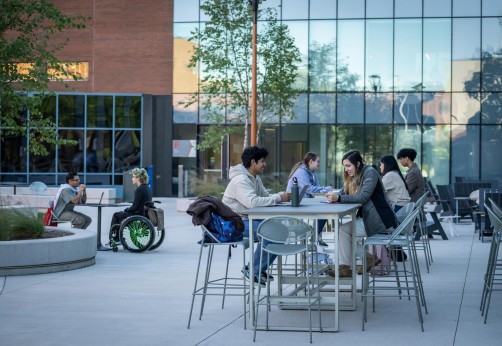
At Fanshawe College, student life is about more than just academics—it’s about creating unforgettable experiences, building connections, and finding your place in a vibrant and supportive community. From modern housing options and competitive athletics to inclusive events and campus services designed to meet your needs, Fanshawe offers a well-rounded environment where you can thrive. Discover what it means to be a part of Fanshawe and make the most of your college journey.
Included In Your Fanshawe Experience
Guaranteed Residence for First Year Students
*Must apply and pay fee
Comprehensive Campus Services
Commitment to Diversity and Inclusion
Make the Most of Your Fanshawe Experience
Student life at Fanshawe is about supporting you in all aspects of campus living. From finding the right place to live to accessing campus services, using your FANCard, staying active through athletics, or preparing for graduation — we’re here to make your time at Fanshawe smooth, comfortable, and memorable. These services are all part of making your student experience complete.
Residence & Housing
View on-campus residence suites, or off-campus housing support to help you find safe, affordable options nearby.
Campus Services
Find info on campus security, meal plans, the test centre, media support, and retail services.
Athletics
Fanshawe College has one of the best varsity athletic programs in Ontario! Find all the information you need on our varsity teams.
Fanshawe Student Union
Find out about your student council, join clubs, view events and contests, and get information about your bus pass and health plan.
FANCard
Your FANCard is your official Fanshawe identification card that also serves as your meal plan, bus pass and much more!
Bus Pass
Students attending the London Campus receive a London Transit Commission (LTC) bus pass. Your FANCard will work as your bus pass.
Convocation
Celebrate your achievement with family and friends at Fanshawe’s convocation ceremony.
Pride at Fanshawe
We value the diverse sexual and gender identities and expressions that make up our community.
Related Blog Posts
Staying cool: 7 simple tips for hot summer days
Warm weather is a great time to get outside and enjoy campus life. With rising temperatures, it’s also a good idea to take a few simple steps to stay comfortable and avoid heat-related issues.
At a glance: staying cool checklist
- Drink water regularly and bring a refillable bottle
- Wear sunscreen, a hat and sunglasses outdoors
- Choose light, breathable clothing
- Take breaks in shaded or air-conditioned spaces
- Plan outdoor activities for cooler parts of the day
- Check in on friends, classmates and neighbours
- Know the early signs of heat-related illness
Everyday tips for students
1. Build good hydration habits
Drink plenty of water, even if you’re not thirsty. Your body loses fluid through sweat as it works to stay cool. Staying hydrated helps regulate body temperature, support vital functions like your kidneys and muscles, and reduce the risk of dehydration.
Generally speaking, in hot conditions the human body needs to replace approximately one cup (250 mL) of fluid every 20-30 minutes.
Tips:
- Heading to class or commuting? Bring a reusable water bottle and sip throughout the day.
- If you’re sweating a lot, especially during physical activity, replacing electrolytes can help maintain balance and prevent fatigue.
- You can also boost hydration with foods like watermelon, cucumbers and oranges. Light snacks like fruit can help keep your energy up while adding to your fluid intake.
2. Seek out cool spaces
Air-conditioned spaces can offer a welcome break from the heat. Spend time on campus or visit community spaces like libraries, community centres or malls when you need to cool off.
Spending time outside?
- If you’re walking or taking transit, look for shaded routes and take short breaks indoors when you can.
- If studying outdoors, choose shaded areas and take regular breaks to cool off.
Learn more about local cooling spaces in your community:
- London: https://london.ca/cooling-centres
- Middlesex County: https://library.middlesex.ca/locations
- St. Thomas and Woodstock: https://www.swpublichealth.ca/community-health/environmental-health/weather-alerts/extreme-heat/
- Haldimand and Norfolk Counties: https://geph.ca/public-health-topic/environmental-health-and-safety/extreme-weather-notifications/
3. Dress for the weather
Choose lightweight, loose-fitting, breathable clothing. Light-coloured fabrics can help you stay cooler. A wide-brimmed hat and sunglasses offer added protection from direct sun.
Don't forget to apply sunscreen generously. If you’re spending time outside, apply skin protection before heading out (the higher the SPF, the better) and reapply more every couple of hours, especially if you’re sweating or swimming.
4. Plan activities thoughtfully
Try to schedule walks, workouts or outdoor activities during cooler parts of the day, whenever possible. Aim for early morning or evening when temperatures are lower. Keep water nearby and consider drinks with electrolytes after longer or more intense activity.
5. Look out for each other
Hot weather can affect people differently. Older adults, young children and those with certain health conditions may be more sensitive to heat. Take a moment to check in with friends, family or neighbours who may need extra support.
Don’t forget your pets! Make sure animals always have access to fresh water and shade. Avoid walking them on hot pavement and never leave them in parked vehicles.
6. Know the signs of heat-related illness
Be aware of symptoms like swelling, rash, cramps, dizziness, fainting or fatigue. Recognizing these warning signs early can help you cool down, recover more quickly and prevent more serious issues.
Heat stress can affect anyone, anytime.
- Our bodies naturally maintain a temperature between 36 and 38 C. Sweating cools us down, but in very hot conditions this may not be enough.
- When a human body cannot adequately remove excess heat, the body's core temperature rises and the heart rate increases. This can lead to heat stress, heat exhaustion and heat stroke.
- Factors affecting heat-related illness can include: direct sun exposure, high temperature, high humidity, limited air movement, physical exertion, pregnancy, medications, pre-existing health conditions, weight, age and health history.
- The most effective way to reduce the risk of heat-related illness is through prevention.
7. Stay informed
Keep an eye on local weather forecasts and public health updates for tips and guidance throughout the summer:
- Middlesex-London Health Unit
- Southwestern Public Health
- Grand Erie Health Unit (formerly Haldimand-Norfolk Health Unit
- Environment Canada
By planning ahead and taking a few simple steps, you can stay comfortable, enjoy the season safely and remain ready for whatever summer brings your way!
Related Blog Posts
Beyond the screen: understanding TFSV
With contributions from: Mackenzie Hartung, MPS, B.A. (Hons), former Sexual Violence Prevention Coordinator, Fanshawe College
Every day we spend a great deal of our lives online: connecting with friends, sharing ideas, forming and building relationships. Technology makes it easy to share parts of ourselves; but the same spaces that help us stay connected can also be misused to cause harm. As our reliance on digital tools has grown, technology-facilitated sexual violence (TFSV) has become a serious and rising concern on Canadian college and university campuses. Now more than ever, it is crucial to understand what TFSV looks like, why it matters and where to find support.
What is Sexual Violence?
Sexual violence is an umbrella term that covers a spectrum of harmful behaviours and attitudes that actively target an individual’s sexuality, gender identity or gender expression (Salvino et al., 2017). The World Health Organization defines sexual violence as “any sexual act, attempt to obtain a sexual act, or other act directed against a person’s sexuality using coercion, by any person regardless of their relationship to the victim, in any setting” (WHO, 2002).
Sexual violence can happen to anyone, anywhere, by anyone, although young women experience the highest rates of sexual violence in Canada.
Sexual violence is never about love, passion or desire. It is rooted in power and control, and can be perpetrated through many means, including physical force, verbal manipulation, coercion, threats, or pressure (YWCA Canada, 2020).
What is Technology-Facilitated Sexual Violence?
Technology-facilitated sexual violence (TFSV), also called Technology-facilitated gender-based violence (TFGBV), refers to any form of sexual violence that is carried out through the use of technology. This can happen through phones, social media, messaging apps, dating apps, gaming platforms or anywhere we connect online. It can involve devices like phones, tablets, or digital cameras and webcams. TFSV is part of the same spectrum of gender-based and sexual violence we see offline; the difference is that it happens through technology.
TFSV can happen anytime, anywhere and often anonymously. It can be obvious or subtle (or sometimes it may not feel serious at first but it still crosses boundaries. It happens anytime someone uses digital platforms to pressure, control, harass or violate your consent. These aren’t minor annoyances; they are red flags that should never be tolerated.
It is never OK to use technology to shame, embarrass, harass, hurt, manipulate, threaten or take advantage of someone!
The impact of TSFV on students
Technology is woven into almost every part of student life, but it can also be misused to cause harm. Digital platforms give people unprecedented power to shame or harm others: things can spread fast, reach huge audiences and often go unpunished (Henry and Powell, 2018). TFSV is now one of the fastest-growing forms of gender-based violence on Canadian campuses. The reality is that most students have either experienced it themselves or know someone who has.
Recent research shows just how widespread this issue is: more than 4 in 5 Canadian undergraduate students, roughly 80%, report experiencing some form of online sexual violence. That includes everything from unwanted sexual messages, explicit comments, and harassing emails to online stalking, coercive behaviour, and receiving unwanted explicit photos.
These are forms of violence. Even through a screen, the impact is just as real and serious.
For many students, the harm can affect mental health, friendships and relationships, academic performance and their overall sense of wellbeing. Students describe feeling anxious, ashamed, isolated or unsafe, both online and in real-life spaces on campus. Worse still: because digital violence can follow someone across platforms and devices, it can feel like there’s no real off switch. Once something is online, it can feel impossible to escape or control who sees it or where it ends up.
Who is affected by TFSV
Anyone can experience TFSV. Unfortunately though, the harm isn’t experienced equally; certain groups are targeted far more often. Women aged 15–24, 2SLGBTQIA+ students, Indigenous students and racialized students experience disproportionately high rates of digital harassment, online sexual violence, and image-based abuse (YWCA: "Not Online. Not On Campus."). These students not only face higher levels of violence but may also encounter more frequent or more severe forms of it.
What to do about TFSV
You don’t need to have the “right” label for what you experienced.
If something online makes you feel unsafe, pressured, embarrassed or "off" somehow, it is worth paying attention to. Many students will minimize their experiences because they were not physical. In reality, TFSV can seriously impact someone’s life.
Help is available
If you have experienced any form of digital violence, intimidation, manipulation or cruelty, you are not imagining it and you are not blowing it out of proportion. Remember that statistics show a huge portion of Canadian students have been there too.
If anything crossed your boundaries or made you uncomfortable:
- Talk to someone you trust (e.g. a friend, peer, campus support)
- Reach out to a specialist like Fanshawe’s SVPC for support, even to ask questions
- Get help sooner rather than later – support is available even if you don’t want to make a report. You deserve to feel safe, online and offline.
Experiencing TFSV or any form of sexual violence or gender-based violence can feel overwhelming, but you don’t have to navigate it alone.
Supports at Fanshawe College
Technology-facilitated sexual violence is real, harmful and far more common than many realize… but you are not alone, and what happened to you is not your fault.
You deserve to feel safe, respected and supported – online and offline.
Fanshawe offers supports, no matter how big or small the situation feels. Students have access to confidential, trauma-informed supports, whether the incident happened on campus, off campus, online or even before you became a student here. You do not need to file a formal complaint to access help or support.
Reach out when you feel ready, and we can help discuss your options for medical care and counselling, before or after disclosing an incident, and also for reporting if you choose to do so. You will not be pressured to do any of these things. Whether you chose to pursue care or provide a statement, or not, you will be provided with information to help support you.
Sexual Violence Prevention Coordinator
The SVPC is a confidential support for students who have ever experienced sexual violence or gender-based violence. Support will be tailored to the student’s needs and can range from understanding reporting options, to safety planning, to assistance navigating campus and community resources.
Contact:
519-452-4465
svsupport@fanshawec.ca
Room F2010 (Red Zone, London Campus)
Learn more →
Counselling
Free counselling services for students, available in-person, online or over the phone. Fanshawe is here to, listen, support, believe and help you decide what feels right for you. Whether you want to ask questions, explore your options, report an incident or simply talk to someone, support is always available without barriers.
Contact:
counselling@fanshawec.ca
Room F2010 (Red Zone, London Campus)
Learn more →
Campus Security Services
Fanshawe’s CSS provides emergency response, reporting, safety plans and coordination with London Police. We offer personalized safety plans and risk assessments for individuals feeling unsafe (whether this is because of incidents that occur on campus, off campus or online). Contact CSS if you are interested in safety planning.
*Note: It is often difficult to disclose and report incidents of sexual violence; however, we strongly encourage you to do so. It is entirely up to you if you choose to report an incident; but if you disclose violence to us, we will need to report the incident to the London Police Service. Campus Security’s role is to assist the London Police and also to complete a separate Student Code of Conduct investigation. For further information on the reporting process, you can contact Campus Security Services.
Contact:
519-452-4400 (non-emergency) | 519-452-4242 (emergency)
security@fanshawec.ca
Security Control Centre, room D1027 (Green Zone, London Campus)
Learn more →
* Reports can also be made through the StaySafe App.
You are not alone
Everyone deserves to feel safe and respected—online and offline. If something doesn’t feel right, please reach out, ask questions or simply talk to someone you trust. Remember that support is available, and you don’t have to handle it on your own. Help is here, confidential and ready when you need it.
16 Days of Activism
The 16 Days of Activism Against Gender-Based Violence is an annual international campaign, led by UN Women. Every year from November 25 to December 10, people around the world take part in the 16 Days of Activism Against Gender-Based Violence. This campaign started in 1991 and calls for action to end violence against women, girls and 2SLGBTQI+ communities. Canada participates by raising awareness and renewing commitments to prevent gender-based violence through advocacy, resources and community engagement.
2025: End digital violence
This year’s theme focuses on digital violence, urging for a world where technology serves equality, not harm. The campaign highlights how technology can be misused to harass, control or harm and how online spaces can amplify abuse. It calls for stronger policies, education and support systems to protect those at risk. The 16 Days begin on the International Day for the Elimination of Violence Against Women and end on Human Rights Day, reminding us that safety and respect are basic rights.
UN Women | Join the UNiTE campaign to stop digital abuse
Canada.ca | About the 16 Days of Activism Against Gender-based Violence
Additional resources and learning
Community Resources
Anova, London Ontario | Resource for all survivors of sexual violence (women’s shelter, sexual violence counselling, workshops and more)
- 24/7 crisis support line: 1-800-265-1576 or 519-642-3000
Assaulted Women’s Helpline – 24/7 support in Ontario (confidential and anonymous)
- 1-866-863-0511 or 416-863-0511
- #SAFE (#7233) on Bell, Rogers, Fido or Telus mobile phone
Atlohsa Family Healing Services | Indigenous led programs and services (holistic healing, shelter, education support)
- 24/hr crisis line: 1-800-605-7477
Learn more about TFSV
- Fanshawe Student Union (FSU) | Gender-Based and Sexual Violence Support and Education
- Simon Fraser University | Technology-Facilitated Sexualized Violence
- Tech Safety Canada | Legal Protections for TFGBV: What Laws Apply to You?
- The Conversation | Canadian schools need to address digital sexual violence
- Computers in Human Behaviour (via Science Direct) | Technology-facilitated sexual violence among sexual and gender minority youth
- Ending Violence Association of BC | Intersectional Resources to Prevent Sexualized Violence
- BCcampus Open Publishing | Power Dynamics and Boundaries: A Sexualized Violence Prevention Workshop for Graduate Students
- Western News | Expert insight: Tackling digital sexual violence in Canada requires updated policies
References
- Henry, N., & Powell, A. (2018). Technology-Facilitated Sexual Violence: A Literature Review of Empirical Research. Trauma, Violence & Abuse, 19(2), 195–208. https://www.jstor.org/stable/26638194
- Salvino, C., Gilchrist, K., & Pang, J. (2017). “OurTurn: A National Student-Led Action Plan to End Campus Sexual Violence”. Students’ Society of McGill University, online, https://static1.squarespace.com/static/5bc4e7bcf4755a6e42b00495/t/5c2fa6921ae6cf 5f6c71821b/1546627650779/OurTurn+Action+Plan.pdf.
- Snaychuk, L. A., & O’Neill, M. L. (2020). Technology-Facilitated Sexual Violence: Prevalence, Risk, and Resiliency in Undergraduate Students. Journal of Aggression, Maltreatment & Trauma, 29(8), 984–999. https://doi.org/10.1080/10926771.2019.1710636
- World Health Organization. (2022). Sexual violence. Violence Info. https://apps.who.int/violence-info/sexual-violence
- YWCA Canada. (2020). Not Online. Not on Campus. https://ywcacanada.ca/wp-content/uploads/2020/07/Not-Online.-Not-On-Campus.-Report-FINAL-06-30.pdf
Related Blog Posts
Traffic Rules on Campus and Traffic Safety Tips
As the school year ramps up, so does traffic on campus. Bikes, cars, pedestrians, buses and more pass through campus. As a community, Fanshawe College works together to keep campus safe for everyone.
Help keep our campus safe by following these traffic safety rules
With ongoing construction and a surge in new students, our campus roadways are busier than ever!
Your safety and the safety of everyone in our campus community is paramount. Campus Security is urging safe driving habits: stick to the 25 km/h speed limit, follow posted signs and rules, drive with your full attention and be considerate of pedestrians.
Here are some key points to keep in mind.
Obey traffic signs and rules
Whether you drive, cycle or walk, follow traffic signs and rules diligently. Stop at stop signs, yield to pedestrians at crosswalks, and maintain a safe speed.
Yield for pedestrians
Foot traffic is high this fall. Always yield to pedestrians, even outside designated crosswalks. Respect your fellow Falcons' right to feel safe while moving around campus.
Construction zones
Exercise caution in and around ongoing construction areas. Follow any detours or temporary traffic signs for your safety.
Be patient
During peak hours, traffic can get busy. Expect delays. Plan your commute ahead of time and leave early to avoid rushing. Patience and courtesy help prevent accidents. Review the campus map ahead of time and stay aware of campus News and road closures.
Stay informed
Familiarize yourself with our campus traffic regulations: review our Policy C203: Parking and Traffic.
Let's work together to keep Fanshawe safe for motorists, pedestrians and everyone. By following these guidelines and showing consideration, we can improve traffic safety and reduce incidents on our campus roads.
For more information, contact Campus Security Services.