Program Overview

Build a strong foundation for your business career at the Lawrence Kinlin School of Business. Its four-year Honours Bachelor of Commerce program is designed for ambitious future leaders seeking a dynamic, hands-on learning experience. Tailor your business degree to fit your career goals. Choose from six specialized majors: Accounting, Digital Marketing, Finance & Wealth Management, Management, Human Resources Management, or Supply Chain & Operations. You’ll graduate with deep expertise, real work experience, direct industry connections and job-ready leadership confidence.

Program Details

Program Code
BCC1
Credential:
Degree
Duration
4 years
Start Dates
Locations
Availability

Full Time Offerings

2027 September
London
Open
Start Dates
Locations
Availability

Full Time Offerings

2027 September
London
Open

Your Learning Experience

At the Lawrence Kinlin School of Business, your four-year Honours Bachelor of Commerce degree combines rigorous academic instruction with practical, experiential learning. Working in collaborative modern classrooms, you will solve complex business challenges, participate in industry capstone projects, and engage directly with regional business leaders. A requirement for graduation is the completion of a co-op education work term that combines your studies with paid, related experience to build your resume.

This business degree balances core strategic business competencies, including corporate strategy, business analytics and ethical leadership, with specialized upper-year coursework tailored specifically to your chosen major.

You will graduate with the strategic insight, practical experience and professional networking foundation needed to step seamlessly into mid-level management roles or pursue post-graduate degrees and professional designations across Ontario and beyond.

A fully accredited four-year business degree with hands-on practical experience.

Fanshawe’s Honours Bachelor of Commerce undergraduate degree offers the same high-calibre business education as a university degree, coupled with the practical, real-world application that a college education is known for. Begin with a comprehensive core business foundation in year one, giving you the flexibility to explore key industry pillars before declaring your major:

  • Accounting: Prepare for CPA pathways by mastering auditing, tax and financial analysis strategies.
  • Digital Marketing: Master data-driven campaigns, SEO, social strategy and e-commerce analytics.
  • Finance & Wealth Management: Prepare for CFP®, QAFP™and PFP® designation pathways by developing skills in investment strategies, risk management and financial planning.
  • Human Resources Management: Build expertise in talent development and labour relations while preparing for CHRP and CHRL professional designation pathways.
  • Management: Develop high-impact strategic planning, decision-making and entrepreneurial leadership skills.
  • Supply Chain & Operations: Build skills in global logistics, procurement and sustainable operations, while gaining advanced standing toward the CSCL designation.

You’ll learn directly from experienced faculty, analyze complex case studies, and use industry-standard technologies to gain a competitive edge in today’s global marketplace.

Emma Z Headshot

"I chose the business degree in digital marketing because practical experience was important to me when deciding on my education, and this degree program had a co-op opportunity too. I'm currently in my 8-month co-op as a marketing assistant, where I not only apply my skills but also learn from industry experts and gain a comprehensive understanding of a genuine work environment.”


Emma Z
Digital Marketing Student
Flexible Business Degree Pathways

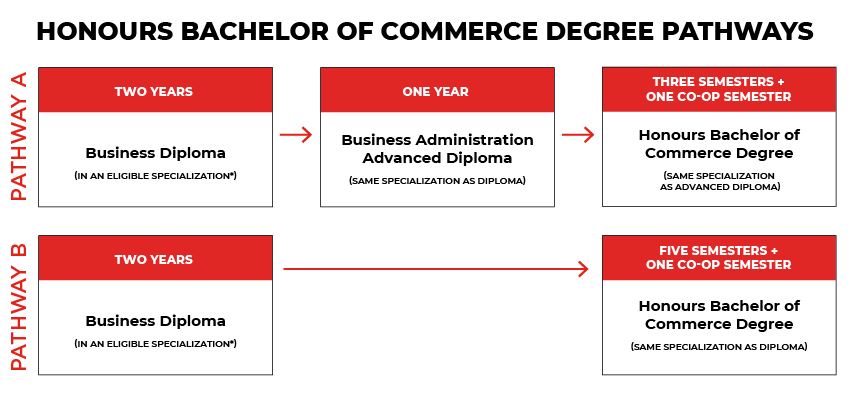
Fanshawe’s Honours Bachelor of Commerce degree offers flexible pathways designed to meet you where you are in your educational journey. You may enter the degree directly from high school or receive advanced standing after completing a related business diploma or advanced diploma.
Image
*Pathways A and B will begin with the successful completion of the Business diploma program.

Students entering directly from high school will study full-time in person. Diploma and advanced diploma graduates may choose full-time or part-time study, with in-person or online delivery options, allowing learners to select the pathway that best fits their schedule and goals. To learn more about pathway eligibility, review the Advanced Standing section within the Admissions Requirements (linked to admissions).

Laptop Requirements

This program requires a laptop. It is recommended that students use a PC laptop vs. a Mac laptop as Windows is required to be able to load program-specific software. For more information on specific requirements, visit the Laptop Requirements page on the Fanshawe CONNECTED website.

Co-op Opportunities & Career Information

Co-op Opportunities

The Honours Bachelor of Commerce degree program offers a co-operative education component, which provides students with the opportunity to gain invaluable first-hand work experience in their chosen field. Here are some co-op jobs that have kick-started the careers of business degree students before they even graduated!

Accounting Majors:

Staff Accountant - review and audit financial statements, develop cash flows and prepare personal and corporate tax returns.

Accounting Assistant - participate and assist in month-end processes such as account reconciliations, journal entries, account verification, and report preparation.

Digital Marketing Majors:

Digital Marketing Assistant - assist in the marketing and presentation of a company’s online presence.

Marketing Coordinator - support all promotional activities by implementing the tactics identified in a marketing plan.

Finance & Wealth Management Majors:

Financial Services Assistant - help create and edit financial plans and coordinate the execution of those plans with investment advisory firms, insurance professionals and banks.

Financial Advisor - work with financial teams to develop comprehensive financial plans that align with a client’s unique investment, retirement and estate planning goals.

Human Resources Management Majors:

HR Coordinator - provide support through the development and management of policies and procedures.

HR Assistant - support a large company with their values and engagement, recruiting, onboarding and training, health and safety procedures, and employee relations

Management Majors:

Product Manager Intern - assist with day-to-day product operations and manage a cross-functional team to meet project requirements and goals.

Order Management Intern - keep track of customers’ orders and handle the steps involved with fulfilling those orders.

Supply Chain & Operations Majors: 

Purchasing Assistant - support procurement operations by evaluating supplier bids, issuing purchase orders, monitoring inventory levels and maintaining vendor relationships.

Logistics Intern - assist with end-to-end supply chain coordination, including tracking shipments, optimizing freight schedules and streamlining inventory distribution workflows.

Career Information

Graduates of Fanshawe’s Honours Bachelor of Commerce program are prepared to lead organizations through strategic decision-making, financial stewardship, digital innovation and operational excellence. By combining a comprehensive core business foundation with applied, hands-on learning in your chosen major, you will graduate ready to step directly into high-demand roles, pursue professional designations or launch your own entrepreneurial venture.

Depending on your chosen major, graduates are prepared to pursue careers across a wide range of industries, including:

  • Accounting & Taxation (CPA pathways)
  • Digital Marketing & Analytics
  • Financial Planning & Wealth Management (CFP®, QAFP™and PFP®  pathways)
  • Human Resources & Talent Management (CHRP / CHRL pathways)
  • Operations, Logistics & Supply Chain (CSCL pathways)
  • Strategic Business Management & Consulting
  • Entrepreneurship & Venture Development

Did you know Fanshawe consistently ranks high in graduate employment rates among large colleges in Ontario?

Here are just a few examples of career opportunities available across our six degree majors:

  • Financial Planner / Advisory Specialist (Finance & Wealth Management) - help individuals and corporate clients navigate wealth building, investment portfolios, retirement planning, and risk management.
  • Human Resources Generalist / Specialist (Human Resources Management) - drive organizational success by overseeing talent acquisition, employee engagement, labour relations, and corporate strategy.
  • Supply Chain & Logistics Analyst (Supply Chain & Operations) - optimize complex global distribution networks, streamline procurement processes, and lead sustainable supply operations.
  • Staff Accountant / Auditor (Accounting) - manage financial reporting, corporate auditing, tax compliance, and strategic financial planning for public or private firms.
  • Digital Marketing Manager (Digital Marketing) - drive market growth by developing data-driven digital campaigns, SEO strategies, content plans, and e-commerce analytics.
  • Operations & Strategy Manager (Management) - lead cross-functional teams, direct corporate operations, analyze market growth opportunities, and guide organizational change.


Learning Outcomes
  1. Identify the functional areas of business (e.g., management, marketing, human resources, accounting) and recognize how each area contributes to the successful operation of an organization 
  2. Identify and assess the performance of an organization by collecting and interpreting data, and preparing and analyzing financial statements as well as other reports 
  3. Identify and examine interrelated (internal and external) factors that influence organizational culture and employee behaviours and performance 
  4. Define and assess the business environment and objectives of an organization to plan marketing initiatives based on core marketing principles 
  5. Plan, implement, and evaluate projects and programs, using project planning principles and tools 
  6. Recognize and adhere to the legal, ethical, economic, social, and professional frameworks within which an individual and organization operate 
  7. Analyze and evaluate the role of sectors, environments (local, domestic, global), organizational structures and sizes, and the interdependence of functional areas in the development and implementation of strategies supporting organizational objectives 
  8. Develop a comprehensive business plan based on relevant research that integrates business principles, best practices, and environmental considerations 
  9. Apply social intelligence and communication skills to build and nurture mutually beneficial relationships with internal and external stakeholders as appropriate in an inclusive, diverse, globalized business culture 
  10. Research, analyze, critically evaluate and communicate qualitative and quantitative data from appropriate sources to support strategic and operational decisions 
  11. Evaluate and describe the purpose of existing and emerging technologies and leverage systems [that collect, organize, analyze, and communicate information] to support the achievement of organizational objectives 
  12. Evaluate and implement risk management strategies and processes to support individual and organizational performance and success 
  13. Set goals and adopt strategies to engage in life-long learning and personal professional development that promotes currency and innovation with emerging trends and technologies 
  14. Analyze financial goals and create budgets that classify income, savings, debt obligations, and other expenses, to make informed decisions over varying timelines
Additional Learning Outcomes by Degree Major:
Accounting
  1. Analyze financial goals and create budgets that classify income, savings, debt obligations, and other expenses, to make informed decisions over varying timelines
  2. Evaluate financial information for decision-making purposes, including the assessment of the financial performance, risk management and valuation of a project and entity 
  3. Research and apply accounting standards and theoretical frameworks to prepare, analyze, and interpret financial statements 
  4. Prepare, analyze, and interpret individual and corporate tax returns in accordance with relevant legislation and regulations 
  5. Apply tax principles and concepts, including tax planning, to complex tax situations of individuals, partnerships, corporations, and trusts 
  6. Support management decision-making in planning, controlling, forecasting, cost and revenue management, and performance measurement 
  7. Plan, perform, and report on assurance and other engagements based on client needs and in accordance with applicable frameworks and standards
Digital Marketing
  1. Research and analyze customer behaviour and manage customer relationships to develop and adapt effective marketing strategies, tactics, and communications 
  2. Create, adapt, and evaluate branding strategies that convey an organization's values and maximize brand equity 
  3. Design, develop, and maintain a secure, engaging, and accessible website using a content management system and search engine optimization techniques 
  4. Develop and implement a search engine marketing plan for an organization to leverage online visibility to increase brand awareness and support revenue generation 
  5. Develop and implement strategic and digital marketing initiatives for an organization, including developed and user-generated content aligned with the brand, to promote a product or service 
  6. Select and assess relevant metrics for measuring the performance and effectiveness of digital marketing strategies and tactics 
  7. Develop, assess, execute, and optimize marketing strategies that align with organizational objectives to enhance financial performance 
  8. Research and analyze new marketing trends, tools, and techniques, and apply them to optimize customer engagement and marketing performance
Finance & Wealth
  1. Articulate and adhere to the responsibilities and ethical standards of financial planning and investment management professionals and to the regulatory requirements in the Canadian financial services sector. 
  2. Analyze client goals, objectives, and financial information as well as economic variables to recommend comprehensive personal financial planning strategies addressing cash flow, debt repayment, risk management, investment management, and estate and tax efficiency.
  3. Apply statistics, data analysis, and the time value of money to support financial decisions.
  4. Evaluate a company’s corporate governance, capital budgeting, and capital structure to optimize the firm’s value.
  5. Research and apply financial reporting standards and accounting methods to analyze and interpret financial statements
  6. Explain and analyze portfolio construction and management techniques inclusive of various investment types, including money market, fixed-income, equity and derivative securities, and alternative investments.
Human Resource Management
  1. Design evidence-based human resources management policies, procedures, and programs based on internal and external environmental factors to align with the strategic and operational goals of an organization 
  2. Develop, implement, and support the recruitment and management of staff, training and development, performance management, and compensation and retention strategies for an organization 
  3. Develop strategies to foster positive employee relations, mediate and manage disputes and grievances in unionized and non-unionized environments, and negotiate collective agreements 
  4. Support the development, implementation, and management of an organizational change plan for promoting organizational development and improving performance 
  5. Interpret and apply statute and common law principles, including employment and occupational health and safety laws, to the operation of an organization 
  6. Use human resources information systems (HRIS) to make evidence-based decisions that enable human resources departments to perform effectively and strategically 
  7. Examine the social, cultural, political, and legislative dimensions of human resources management policies, procedures, and programs for domestic and transnational organizations
Management
  1. Identify, adapt, and apply appropriate leadership styles to inspire and motivate a diverse group of individuals to achieve personal and organizational goals 
  2. Develop operational plans, including allocation, direction, control, and coordination of human resources, to achieve the strategic goals for organizations of various size and type, including public, private, and not-for-profit 
  3. Construct an organizational design based on comprehensive analysis of internal and external environments to support the achievement of the strategic and operational goals and enhance performance 
  4. Examine the social, cultural, political, and legislative dimensions of international markets to develop strategies for organizations to compete on a global scale 
  5. Plan, implement, and evaluate the sales function of an organization to effectively manage customer relationships and to maximize efficiency and profits for the organization 
  6. Foster positive relationships with and among employees, and develop, implement, and manage an effective performance management process
Supply Chain & Operations
  1. Develop, implement, evaluate, and adapt strategic plans and schedules for material, resources, and inventory for efficient production and fulfillment of customer orders and returns
  2. Define, apply, and analyze product and service design processes, practices, tools, and systems required in manufacturing, distribution, and service organizations. 
  3. Examine the connections between strategic objectives, stakeholder expectations, and supply chain design, functions, processes, and roles, to guide decision-making, problem-solving, and the coordination of tasks
  4. Coordinate, monitor and manage the efficient handling and movement of goods, services, materials and relevant information within and between supply chain partners domestically and internationally.
  5. Identify, recommend, and implement quality methods and continuous improvement initiatives to various functions and processes within a supply chain and across the operations of an organization
  6. Facilitate the acquisition and sale of goods, services, and materials in accordance with best practices and public and private sector stakeholder expectations across a variety of industries
  7. Use appropriate technologies, including Enterprise Resource Planning (ERP) systems, related to supply chain and operations functions, processes, transactions, and communications to enhance work performance


Program Coordinator:
Laura De Luca, MBA, CPA, CGA, CIA, CISA

Academic Advisor:
Katie Helmeczy
 

Admission Requirements

Ontario Secondary School Diploma (OSSD), or equivalent, or mature applicant with the following courses:

  • Grade 12 English (U) - minimum final grade of 65%
  • Grade 12 Mathematics (U) - minimum final grade of 65%
  • Four additional Grade 12 U or M level courses
  • Final minimum average of 65% based on the highest six Grade 12 (U or M) courses required

Applicants with Post-secondary Education

Applicants who have successfully completed a non-related two-year diploma at an accredited college with an overall GPA of 3.0 will be considered as having met the admission requirements into Level 1 if they also have grade 12 (or equivalent) U level Math and English courses.

Applicants applying from a university with a minimum average of 65% in the last ten full credit or full credit equivalent courses will be considered as having met the admission requirements if they also have grade 12 (or equivalent) U level Math and English courses.

Students missing the required courses may want to consider starting with our Business Fundamentals certificate or Business Accounting diploma program and later transferring to the degree program.

International Admission Equivalencies
Admission equivalencies for Fanshawe depends on your country of study. Please enter your location to see the requirements for your country below.
Recommended Academic Preparation

Recommended Academic Preparation

In addition to required mathematics courses in secondary school, students are encouraged to take additional mathematics and accounting courses.

Recommended Personal Preparation

Recommended Personal Preparation

Students are encouraged to strengthen their critical thinking, problem solving and time management skills prior to entering the program.

Advanced Standing

Advanced Standing

  • Applicants with an Ontario College Diploma in a related business field with a minimum GPA of 3.0 can apply to Level 4 of the Honours Bachelor of Commerce Degree.
  • Applicants with an Ontario College Advanced Diploma in a related business field with a minimum GPA of 3.0 can apply to Level 6 of the Honours Bachelor of Commerce Degree.
  • Applicants applying for individual course credits from Canadian universities must provide a detailed course content of theory and laboratory exercises (if appropriate).
  • International applicants may apply for course credit achieved at the post-secondary level. Detailed course content of theory and laboratory exercises from the international institution must be included with a transcript as part of the request (official documents provided to the Office of the Registrar in a sealed envelope). If translation of the documents into English is necessary this must be performed by a recognized service.
  • Applicants may apply for advanced standing on the basis of previous academic achievement at another institution and/or Prior Learning Assessment and Recognition (PLAR). Advanced standing will be awarded in alignment with Policy A124 and the standards and benchmarks established by the Postsecondary Education Quality Assessment Board.
Applicant Selection Criteria

Applicant Selection Criteria

Where the number of eligible applicants exceeds the available spaces in the program, the Applicant Selection Criteria will be:

  • Preference for Permanent Residents of Ontario
  • Receipt of Application by February 1st (After this date, Fanshawe College will consider applicants on a first-come, first-served basis until the program is full)
  • Achievement in the Admission Requirements
  • Achievement in Post-Secondary Studies* (if applicable)

Note:

*Applicants currently enrolled in a university or who have previously attended university or other post-secondary institutions and are applying to transfer into the Honours Bachelor of Commerce program are considered on the basis of their post-secondary standing. Specifically, applicants currently enrolled in a university or who have previously attended university must maintain a minimum average of 65.0% on the last ten full credit or full credit equivalent courses in order to be considered for admission. Applicants with less than ten full credit courses must maintain a minimum average of 65.0% on all courses in order to be considered for admission.

Ministry Consent and Accreditation

President: Peter Devlin, CMM, MSC, CD, HBA, MSS
Senior Vice-President Academic: Susan Cluett, BSc, MEng, EdD
Vice-President Students, Employees and Culture: Tania Caza, CHRE, MBA, PCC
Dean, Faculty of Business & Hospitality: Silvana MacDonald, PhD
Associate Dean, Lawrence Kinlin School of Business: Darren Johnson, MSc, MBA

Faculty:
A. Fahmy, PhD Accounting
A. Khazaei, PhD-Management, MSc.-Industrial Management
C. Cadotte, MBA
C. Cooke, MBA-Business, MTI, TEP, CPA-CGA
D. Motwani, PhD-Management, MBA-Management, MBA-Marketing
D. Noon, PhD- Communication, MA- Media Studies
E. Thompson, MBA, CPA
E. Pearson, Ph.D. - Leadership
J. Harren, MIR, Cert. CHRL
K. Said, PhD-Accounting, M.Acc
K. Watson, PhD-Management
L. De Luca, MBA, Cert. APM, CRMA, CISA, CIA, CPA-CGA
L. Gray, MA, HBA
M. Little, MBA, CPA
M. Tucker, MA-Economics
M. Van Roestal, PhD-Accounting
N. Budhwani, PhD-Human Resource Development, MBA-Marketing
R. Gill, PhD-Human Resources Management, Cert. CHRL
R. Vatanchi, MBA, Cert. CHRM-CP
S. Abdelkhalek, PhD-Accounting
S. Deakin, Masters of Accounting, CPA
S. Glavas, MBA, CPA
S. Levson, MBA, Cert. CSCMP
S. Nag, PhD-Applied Economics
S. Wang, PhD-Applied Math
S. Webb, LL.M., PhD-Law & Industrial Relations, M.I.R.
T. Cruz, PhD-Media Studies, MA-Media Studies, BA-Business Administration
T. Kanik, PhD-Management
V.Watts, PhD-Mathematics, MPEd-Mathematics Education

Fanshawe College has been granted consent by the Ministry of Colleges, Universities, Research Excellence and Security to offer this degree for a seven-year period starting February 2024. The College shall ensure that all students admitted to the above-named program during the period of consent will have the opportunity to complete the program within a reasonable time frame.

Tuition Summary

Canadian Costs
$19,438.60
Total Cost of Program[1]
International Costs
$78,314.00
Total Cost of Program[1]

[1] Total program costs are approximate and subject to change. They do not include additional fees such as the health and dental plan, bus pass, or general expenses. Learn more about ancillary and additional fees.


Contact/Questions